
Question 4

Find the intervals in which the function

f(x)=x3+1x3,x≠0

is (i) increasing (ii) decreasing.

Solution

Step 1: Differentiate the function

f(x)=x3+x−3
f′(x)=3x2−3x−4
f′(x)=3(x2−1x4)
f′(x)=3⋅x6−1x4
f′(x)=3(x6−1)x4

Step 2: Determine where f′(x)>0 or f′(x)<0

The denominator x4>0 for all x≠0, so the sign of f′(x) depends on the numerator:

x6−1

Solve:

x6−1>0⇒x6>1⇒∣x∣>1
x6−1<0⇒x6<1⇒∣x∣<1, x≠0

Final Result

(i) Increasing intervals

f′(x)>0⇒∣x∣>1
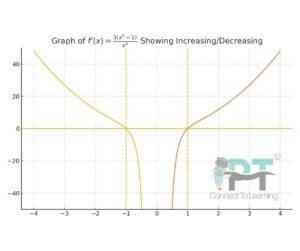
The function is increasing in (−∞,−1)∪(1,∞)

(ii) Decreasing intervals

f′(x)<0⇒0<∣x∣<1
The function is decreasing in (−1,0)∪(0,1)

Summary

Increasing : (−∞,−1)∪(1,∞)Decreasing : (−1,0)∪(0,1)


Let’s check the graph of the given function :

Following is the graph of the derivative of the function:
👋Subscribe to
ProTeacher.in

Sign up to receive NewsLetters in your inbox.

We don’t spam! Read our privacy policy for more info.