
Question 5

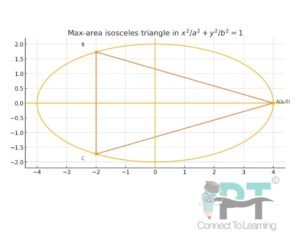
Find the maximum area of an isosceles triangle inscribed in the ellipse

x2a2+y2b2=1

with its vertex at one end of the major axis.

Solution

Assume a>b, so the major axis is along the x-axis.
Take the vertex of the isosceles triangle at the right end of the major axis:

A(a,0).

Let the other two vertices be symmetric about the x-axis (this gives an isosceles triangle and will turn out to be the max–area case):

B(acos⁡θ, bsin⁡θ),C(acos⁡θ, −bsin⁡θ),0<θ<π.

These lie on the ellipse since they are in parametric form:
x=acos⁡θ,y=±bsin⁡θ.

Area of the triangle

  • Base BC is vertical:

    length of BC=2bsin⁡θ.

  • Height is the horizontal distance from A(a,0) to the line x=acos⁡θ:

    height=a−acos⁡θ=a(1−cos⁡θ).

So the area A(θ) of triangle ABC is

A(θ)=12×base×height=12⋅2bsin⁡θ⋅a(1−cos⁡θ)=absin⁡θ(1−cos⁡θ).

We must maximize

A(θ)=absin⁡θ(1−cos⁡θ),0<θ<π.

Maximize A(θ)

Differentiate:

A(θ)=ab(sin⁡θ−sin⁡θcos⁡θ),
A′(θ)=ab(cos⁡θ−(cos⁡2θ−sin⁡2θ)).

Use sin⁡2θ=1−cos⁡2θ:

cos⁡2θ−sin⁡2θ=cos⁡2θ−(1−cos⁡2θ)=2cos⁡2θ−1.

So

A′(θ)=ab(cos⁡θ−(2cos⁡2θ−1))=ab(1+cos⁡θ−2cos⁡2θ).

Set A′(θ)=0:

1+cos⁡θ−2cos⁡2θ=0.

Let c=cos⁡θ. Then

2c2−c−1=0
⇒c=1±1+84=1±34=1, −12.

  • cos⁡θ=1⇒θ=0, which gives zero area, so not a maximum.

  • cos⁡θ=−12⇒θ=2π3in (0,π), valid.

Then

sin⁡θ=sin⁡2π3=32.

Substitute in the area:

Amax⁡=absin⁡θ(1−cos⁡θ)=ab(32)(1−(−12))=ab(32)(32)=334 ab.

Final Answer

The maximum area of the isosceles triangle is 334 ab.


👋Subscribe to
ProTeacher.in

Sign up to receive NewsLetters in your inbox.

We don’t spam! Read our privacy policy for more info.