
Rocks
Origin • Classification • Rock Cycle • Landforms
Rocks: the building materials of Earth
A rock is a naturally occurring solid aggregate of one or more minerals or mineraloids. A mineral generally has a definite chemical composition and an ordered crystalline structure. Granite is a rock; quartz and feldspar are minerals commonly found within it.
| Family | How it forms | Diagnostic clue |
|---|---|---|
| Igneous | Cooling and solidification of magma or lava | Interlocking crystals, glass or vesicles |
| Sedimentary | Deposition followed by lithification; or chemical/biological precipitation | Bedding, grains, fossils or precipitated minerals |
| Metamorphic | Transformation of pre-existing rock without wholesale melting | Foliation, recrystallisation or new mineral assemblages |
What you will master
- Processes of formation and the rock cycle
- Igneous composition, texture and emplacement
- Sedimentary origins, textures and structures
- Metamorphic agents, grades and rock pairs
- Indian examples, landforms and UPSC application
Can one rock contain several different minerals?
The rock cycle: a system, not a fixed sequence
Earth materials continually transform through internal energy (magmatism, uplift and metamorphism) and external processes (weathering, erosion, transport and deposition). The pathways are not a compulsory circular sequence.
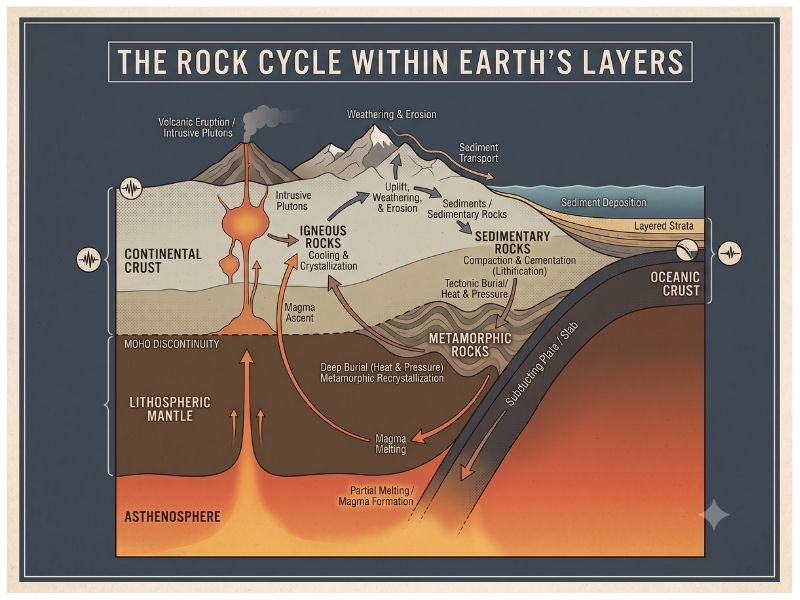
| Process | Transformation | Key distinction |
|---|---|---|
| Crystallisation | Magma/lava → igneous rock | Intrusive cooling generally slower than extrusive |
| Weathering and erosion | Exposed rock → loose material | Breakdown and removal, not lithification |
| Deposition and lithification | Sediment → sedimentary rock | Compaction and cementation |
| Metamorphism | Pre-existing rock → metamorphic rock | Mainly solid-state change |
| Melting | Rock → magma | Partial melting is common in magma generation |
| Uplift and exposure | Deep rock → surface exposure | Makes rocks vulnerable to weathering |
Can a sedimentary rock turn directly into magma?
Igneous rocks I: origin and cooling
Igneous rocks form as molten material cools and solidifies. Magma is molten material beneath the surface; lava is magma erupted at the surface. Cooling rate, volatile content and composition influence texture.
| Setting | Cooling | Common texture | Examples |
|---|---|---|---|
| Plutonic / intrusive (deep) | Generally slow | Coarse-grained | Granite, diorite, gabbro |
| Hypabyssal / shallow intrusive | Variable | Fine to medium; often porphyritic | Dolerite/diabase, porphyry |
| Volcanic / extrusive | Generally rapid | Fine-grained, glassy or vesicular | Basalt, rhyolite, obsidian, pumice |
Textures that tell a geological story
| Texture | Meaning |
|---|---|
| Phaneritic | Crystals large enough to distinguish by eye |
| Aphanitic | Crystals too small to distinguish unaided |
| Porphyritic | Large phenocrysts set in a finer groundmass; reflects contrasting growth histories |
| Glassy | Very rapid cooling inhibits crystal growth |
| Vesicular | Gas bubbles leave cavities as lava solidifies |
Why is granite commonly coarse-grained while basalt is often fine-grained?
Igneous rocks II: composition and identification
Igneous rocks are also classified by silica content and dominant minerals. The traditional textbook terms acidic and basic refer to silica-rich and silica-poorer igneous compositions, not to ordinary pH.
| Composition | General characteristics | Intrusive example | Extrusive example |
|---|---|---|---|
| Felsic / silica-rich | Often lighter coloured; quartz and feldspar common | Granite | Rhyolite |
| Intermediate | Between felsic and mafic | Diorite | Andesite |
| Mafic / relatively silica-poor | Iron–magnesium minerals common; often dark | Gabbro | Basalt |
| Ultramafic | Very rich in magnesium and iron minerals | Peridotite | Komatiite (rare ancient volcanic rock) |
Indian context
The Deccan Traps are a vast province of basaltic lava flows. Layered flows and differential weathering influence plateau and step-like landscapes. The term trap refers to stair-like topography.
Are granite and basalt simply coarse and fine versions of the same composition?
Sedimentary rocks I: from sediment to strata
Sedimentary rocks originate through accumulation of particles, chemical precipitation or biological activity. Many form at or near Earth’s surface, where sediments are deposited in rivers, lakes, deserts, deltas and marine environments.
How sediment becomes rock
- Weathering: Existing rocks break down physically or chemically.
- Erosion and transport: Water, wind, ice or gravity move material.
- Deposition: Sediment accumulates when transporting energy decreases or conditions change.
- Compaction: Burial reduces pore spaces.
- Cementation: Minerals precipitate from groundwater and bind grains together.
Clastic rocks by grain size
| Rock | Typical material | What to remember |
|---|---|---|
| Conglomerate | Rounded gravel-sized clasts | Rounding reflects abrasion and transport history, but context matters |
| Breccia | Angular gravel-sized clasts | May indicate limited abrasion or local fragmentation |
| Sandstone | Sand-sized grains | Often quartz-rich; composition and cement vary |
| Siltstone | Silt-sized particles | Generally finer than sandstone |
| Mudstone / shale | Very fine clay- and silt-sized material | Shale is fissile and tends to split along thin layers |
What is the key difference between conglomerate and breccia?
Sedimentary rocks II: chemical, organic and environmental clues
Sedimentary rocks are grouped by the process that produces them. A useful UPSC approach is to connect rock type with its material, formation process and depositional environment.
| Category | Formation | Examples | Typical clues |
|---|---|---|---|
| Clastic / mechanically formed | Fragments of older rocks are deposited and lithified | Sandstone, shale, conglomerate, breccia | Clasts, grains, bedding |
| Chemical | Minerals precipitate from water, often during evaporation or chemical change | Rock salt, gypsum, some limestones | Evaporite minerals, crystalline precipitates |
| Biochemical / biogenic | Shells and skeletal material accumulate or organisms contribute to deposits | Many limestones, chalk | Fossils or shell fragments may be present |
| Carbonaceous / organic | Plant remains accumulate and are transformed under burial | Peat, lignite, bituminous coal, anthracite | Carbon-rich material; rank varies with coalification |
Sedimentary structures and what they indicate
- Bedding or stratification: Successive depositional layers.
- Cross-bedding: Inclined layers commonly produced by migrating ripples or dunes; can help infer palaeocurrent direction.
- Mud cracks: May indicate drying of wet fine sediment exposed to air.
- Ripple marks: Can record water or wind movement; their shape and context help interpretation.
- Fossils: May reveal past organisms, relative ages and environmental conditions.
Which rock is associated with evaporation of saline water: rock salt or granite?
Metamorphic rocks: transformation without wholesale melting
Metamorphism is the mineralogical, chemical and/or textural transformation of pre-existing rock under changed temperature, pressure, stress and fluid conditions, generally without the rock melting completely.
Major agents of metamorphism
| Agent | Role | Typical context |
|---|---|---|
| Heat | Promotes recrystallisation and mineral reactions | Burial, nearby magma or deep crust |
| Pressure and differential stress | Changes mineral stability and can align platy or elongate minerals | Mountain building and tectonic deformation |
| Fluids | Assist chemical reactions and transport of dissolved components | Hydrothermal systems and metamorphic zones |
Types of metamorphism
- Contact metamorphism: Heating of surrounding rocks near an intrusion; commonly localised.
- Regional metamorphism: Large-scale transformation associated with burial, elevated temperatures and deformation, often in mountain belts.
- Hydrothermal metamorphism: Hot fluids alter minerals and rock chemistry.
- Dynamic metamorphism: Intense deformation and frictional or stress-related effects in fault zones.
Classic rock transformations
| Parent rock | Metamorphic product | Key change |
|---|---|---|
| Shale / mudstone | Slate, phyllite, schist and potentially gneiss with increasing metamorphic grade | Progressive mineral growth and texture change; the sequence is not universal |
| Limestone | Marble | Calcite recrystallises; fossils and original textures may be obscured |
| Quartz-rich sandstone | Quartzite | Quartz grains recrystallise and interlock |
| Granite | Gneiss | Mineral segregation and banding may develop under suitable conditions |
| Conglomerate | Metaconglomerate | Clasts and matrix are deformed or recrystallised |
Does every metamorphic rock show visible bands or layers?
How to identify rocks: use evidence, not a single clue
In a field or examination image, identify the likely rock family first, then look for texture, grain size, mineral composition, layering, fossils and evidence of deformation. A single visual feature is rarely conclusive.

| Observation | Possible interpretation | Do not assume |
|---|---|---|
| Interlocking visible crystals | Often intrusive igneous, or recrystallised metamorphic rock | That all crystalline rocks are igneous |
| Distinct layers and sedimentary grains | Often sedimentary | That every banded rock is sedimentary |
| Foliation or aligned minerals | Often metamorphic | That every metamorphic rock is foliated |
| Vesicles / bubble cavities | Often volcanic rock | That every porous rock is volcanic |
| Fossils or shell fragments | Strong evidence for sedimentary origin in most cases | That all sedimentary rocks contain fossils |
| Rounded or angular clasts | Clastic sedimentary rock; clast shape gives transport clues | That rounding alone identifies a depositional environment |
UPSC method: observe → infer → qualify
- Describe what is actually visible.
- Connect the feature to a rock-forming process.
- Offer the most likely classification.
- State a limitation if the evidence is incomplete.
A specimen shows coarse crystals of quartz and feldspar. Which rock is a reasonable first possibility?
How rock type influences landscapes
Rock type affects weathering, erosion, permeability, soil formation and slope stability. Landforms are not determined by rock type alone: climate, structure, uplift, drainage and time also matter.
| Rock / setting | Landscape relationship | Important qualification |
|---|---|---|
| Basaltic lava flows | Layered plateaus and step-like escarpments may develop through differential erosion | Structure, jointing and climate influence the resulting landforms |
| Limestone | Karst features can include sinkholes, caves, underground drainage and limestone pavements | Requires suitable dissolution conditions, water and rock structure |
| Sandstone | Cliffs, escarpments and joint-controlled forms may develop | Cement, grain size, bedding and climate affect resistance |
| Granite | Jointing and weathering can produce tors, rounded blocks and exfoliation forms | These are process- and setting-dependent, not universal |
| Shale / mudstone | May weather into fine material and form slopes prone to instability | Clay content, water and bedding orientation are important |
| Quartzite | May form resistant ridges where surrounding rocks erode faster | Relative resistance depends on fractures and local conditions |
Indian examples to remember
- Deccan Traps: Extensive basaltic lava flows and plateau landscapes.
- Aravalli and other ancient terrains: Complex assemblages of igneous, sedimentary and metamorphic rocks.
- Himalayas: Diverse sedimentary, metamorphic and igneous rocks shaped by tectonics, uplift, weathering and erosion.
- Limestone regions: Dissolution can produce karst features where geological and climatic conditions permit.
Why can two nearby rock types produce different slopes and landforms under the same climate?
One-page revision: rocks for UPSC
| Rock | Family | Key fact |
|---|---|---|
| Granite | Igneous, intrusive | Usually coarse-grained and felsic |
| Basalt | Igneous, extrusive | Usually fine-grained and mafic |
| Obsidian | Igneous, volcanic | Glassy texture due to rapid cooling |
| Pumice | Igneous, volcanic | Highly vesicular; may float if pores remain open |
| Conglomerate | Sedimentary | Rounded gravel-sized clasts |
| Breccia | Sedimentary or other breccia-forming setting | Angular fragments; origin requires context |
| Sandstone | Sedimentary | Sand-sized grains |
| Shale | Sedimentary | Fine-grained and typically fissile |
| Rock salt / gypsum | Chemical sedimentary | Common evaporite minerals |
| Coal | Organic sedimentary | Derived from plant material through coalification |
| Slate | Metamorphic | Fine-grained; slaty cleavage |
| Schist | Metamorphic | Visible aligned platy minerals are common |
| Gneiss | Metamorphic | Commonly displays compositional banding |
| Marble | Metamorphic | Recrystallised limestone or dolostone |
| Quartzite | Metamorphic | Recrystallised quartz-rich sandstone |
Memory chain
Remember the processes
Magma → cooling → igneous rock
Weathering → transport → deposition → lithification → sedimentary rock
Heat + pressure + fluids → metamorphic change
Melting → magma
The rock cycle is a network of possible transformations, not a compulsory sequence.
Which pair represents a common metamorphic transformation: limestone to marble or granite to sandstone?
UPSC Prelims practice: rocks
Choose one option and select Check answer. Each question gives immediate feedback and a short explanation. Your score updates as you work.
Q1. Granite is generally classified as:
Q2. Which of the following is an extrusive mafic igneous rock?
Q3. A sedimentary rock containing predominantly rounded gravel-sized clasts is:
Q4. Which is a common low-grade metamorphic product of shale?
Q5. Marble commonly forms through metamorphism of:
Q6. Which pair is correctly matched?
Q7. Which statement about fossils is most accurate?
Q8. Lithification mainly refers to:
Q9. The Deccan Traps are primarily associated with:
Q10. Foliation in metamorphic rocks is commonly associated with:
UPSC Mains: structure your answer
Use definitions, processes, examples and a clear conclusion. A small labelled rock-cycle diagram can improve a relevant answer if it is accurate and adds value.
Question 1
Explain the processes through which igneous, sedimentary and metamorphic rocks form. How are they connected through the rock cycle?
Suggested time: 7 minutes
Question 2
Discuss how rock type and geological structure influence the development of landforms. Use suitable Indian examples.
Suggested time: 11 minutes
Question 3
Differentiate between contact and regional metamorphism. Explain how heat, pressure, stress and fluids contribute to metamorphic change.
Suggested time: 7 minutes
Self-assessment checklist
One-minute final revision
Igneous: Cooling and crystallisation of magma or lava.
Sedimentary: Deposition, lithification, chemical precipitation or biological accumulation.
Metamorphic: Transformation of existing rock, generally without wholesale melting.
Rock cycle: Multiple possible pathways driven by internal and external Earth processes.
Landforms: Lithology + structure + climate + geomorphic processes + time.
