
Interior of the Earth
Evidence, seismic waves and the secrets beneath Earth’s surface
How do we know what lies inside the Earth?
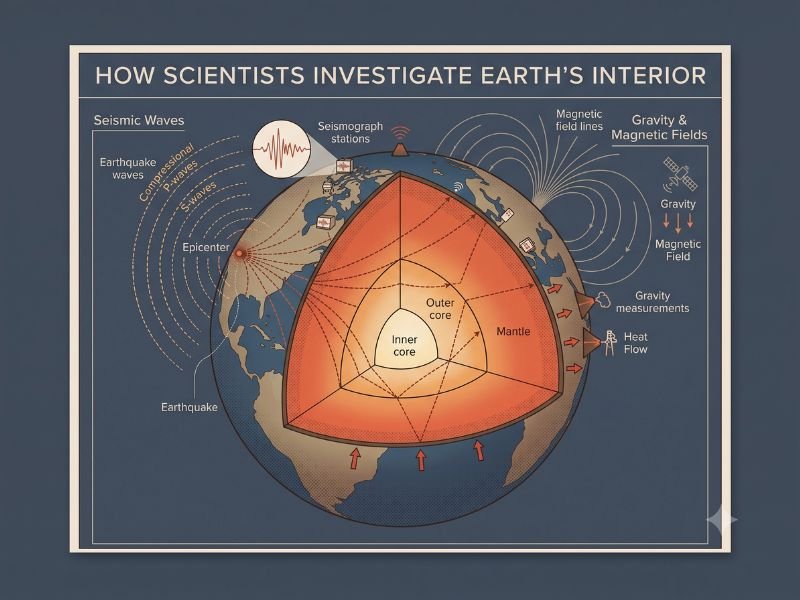
Human beings have directly explored only a very small part of the Earth. The deepest mines and boreholes reach only a tiny fraction of the planet’s radius. Yet scientists have developed detailed models of the Earth’s interior by combining observations from earthquakes, rocks, gravity, magnetic fields, heat flow and laboratory experiments.
Three questions that guide this chapter
What evidence?
Which observations help us infer the composition and physical state of the deep interior?
What do waves reveal?
Why do seismic waves change speed, bend or disappear from certain regions?
What drives change?
How do internal heat, pressure and material movement influence the Earth’s evolution?
How do we infer?
How can scientists move from an observation to a defensible explanation of the interior?
Keep this distinction clear
Structure of the Earth
Describes the layers, their composition, depth and physical characteristics.
Interior of the Earth
Emphasises the evidence, methods and physical processes used to investigate the inaccessible interior.
Why is the Earth’s interior primarily studied using indirect evidence?
Direct and indirect evidence
Evidence about the Earth’s interior is classified broadly into direct observations and indirect geophysical evidence. Each method provides different information and has limitations.
A. Direct sources of evidence
| Source | What it reveals | Limitation |
|---|---|---|
| Surface rocks | Mineral composition and geological history | Most surface rocks do not represent the deep interior. |
| Mines and boreholes | Rock properties and temperature at accessible depths | Depth reached is extremely small compared with Earth’s radius. |
| Volcanic products | Samples of magma and mantle-derived material in some settings | Material may be altered, mixed or unrepresentative of the deeper source. |
| Exposed deep rocks | Materials brought up by tectonic processes | Exposure is geographically limited. |
B. Indirect sources of evidence
| Evidence | Main inference |
|---|---|
| Seismic waves | Internal boundaries, elastic properties and physical state. |
| Gravity and mean density | Constraints on the distribution of mass inside Earth. |
| Geomagnetic field | Evidence consistent with a moving, electrically conducting fluid in the outer core. |
| Heat flow | Information about heat escaping from the interior. |
| Meteorites | Clues about the materials from which the Solar System formed. |
| High-pressure experiments | How minerals and materials behave under deep-Earth conditions. |
How does the average density help?
Earth’s mean density is approximately 5.5 g/cm³, considerably higher than the typical density of common surface rocks. This supports the inference that denser material is concentrated in the deep interior. Density alone, however, cannot specify the exact composition or arrangement of every internal layer.
Which method is most directly used to identify the depth of major internal seismic boundaries?
How seismic waves travel through Earth
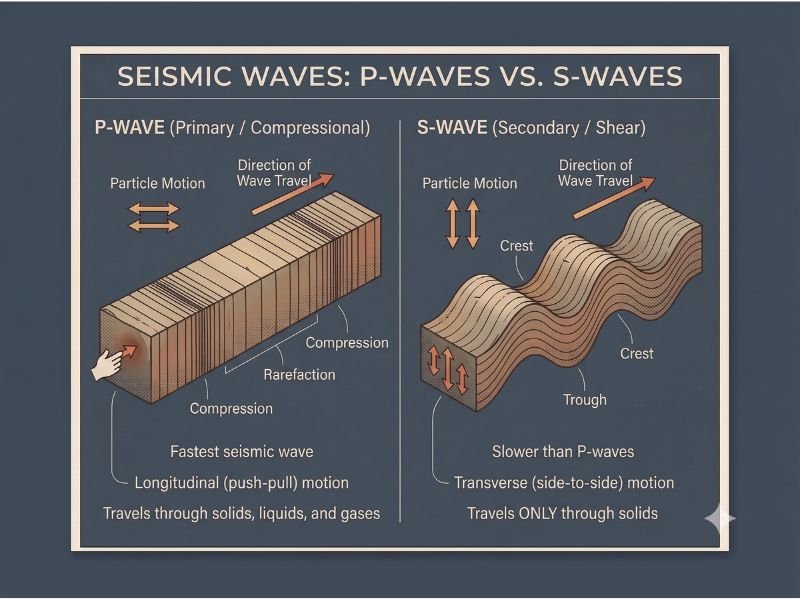
Earthquakes release energy that travels through the Earth as seismic waves. Seismographs record ground motion, and scientists compare observed arrivals with predicted travel times to infer the properties and boundaries of the materials traversed by the waves.
| Property | P-waves | S-waves |
|---|---|---|
| Full name | Primary waves | Secondary waves |
| Wave type | Compressional / longitudinal | Shear / transverse |
| Particle motion | Parallel to the direction of travel | Perpendicular to the direction of travel |
| Through solids | Yes | Yes |
| Through liquids | Yes | No, not as ordinary shear waves |
| Relative arrival | Usually arrive first | Usually arrive later |
What changes a wave’s speed?
- Elastic properties: Material stiffness influences the speed of seismic waves.
- Density: Density also affects wave velocity, along with elastic properties.
- Composition: Different minerals and mixtures have different physical properties.
- Physical state: Liquids cannot support ordinary propagating shear waves.
- Pressure and temperature: These affect material properties and can change wave velocities.
How to interpret a seismic record
- Identify the earthquake origin time.
- Record when P-waves and S-waves arrive at a station.
- Compare their arrival times with theoretical travel-time curves.
- Use observations from many stations to constrain the wave paths and internal model.
Which type of seismic wave cannot propagate through the liquid outer core as an ordinary shear wave?
Seismic shadow zones
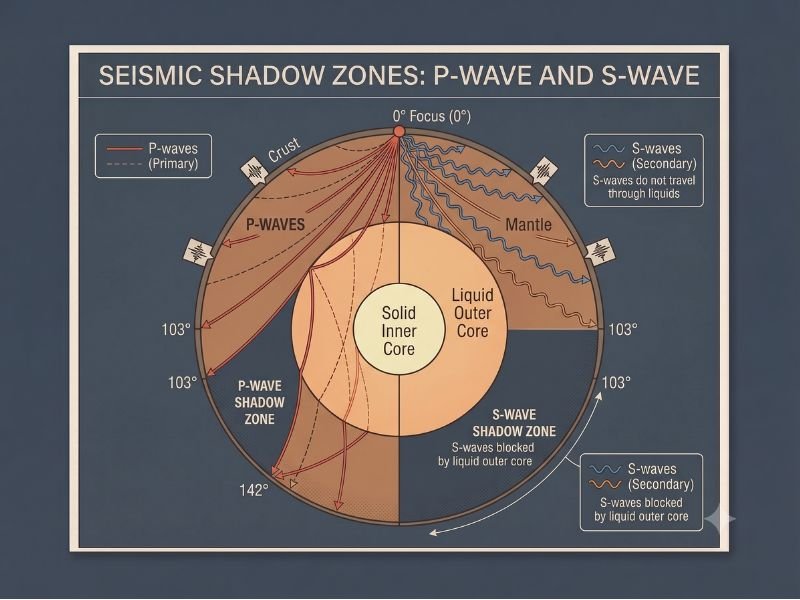
A seismic shadow zone is a region on Earth’s surface where a particular type of direct seismic wave from an earthquake is not recorded as expected. The pattern of missing and refracted waves provides important evidence about Earth’s deep interior.
A. The S-wave shadow zone
In the standard introductory model, direct S-waves are not observed beyond roughly 103° angular distance from an earthquake because they cannot travel through the liquid outer core. This pattern provides strong evidence that the outer core is liquid.
B. The P-wave shadow zone
P-waves can travel through both solids and liquids. However, their paths bend strongly at the core–mantle boundary because their velocities change across the boundary. This creates a prominent direct P-wave shadow zone, conventionally described as approximately 103°–142° from the earthquake.
| Observation | Interpretation |
|---|---|
| Direct S-waves absent beyond the relevant shadow region | Evidence that the outer core does not transmit ordinary shear waves and is liquid. |
| P-wave arrivals change sharply around the core | Evidence of strong refraction and a major velocity contrast at the core–mantle boundary. |
| Seismic waves arrive at distant stations along complex paths | Evidence that the interior is layered and has varying physical properties. |
Think like a geographer
If P-waves can travel through liquids, why is there a P-wave shadow zone?
Discontinuities: reading the Earth’s internal boundaries
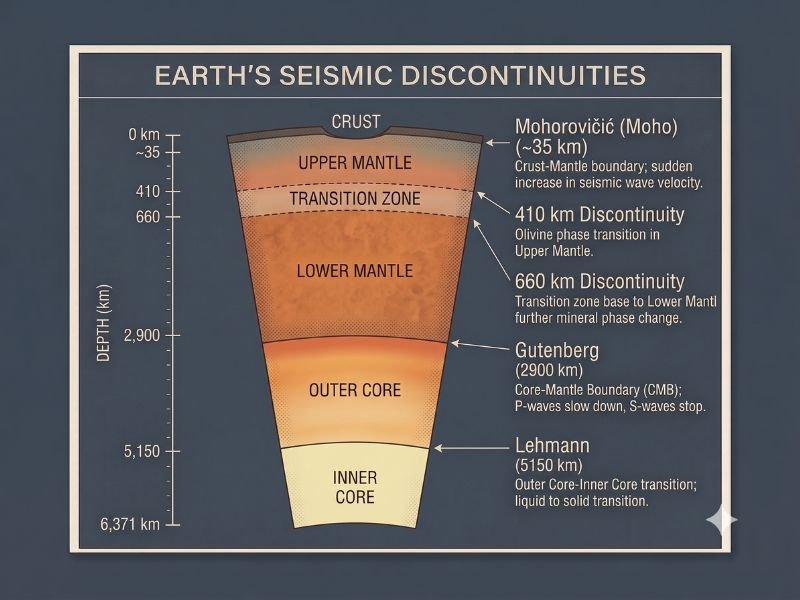
Seismic discontinuities are boundaries or transition zones where seismic wave velocities change significantly. They help scientists map the interior without physically reaching these depths.
| Discontinuity | Approximate depth | Significance |
|---|---|---|
| Mohorovičić (Moho) | Often ~5–10 km beneath oceans and ~30–70 km beneath continents | Boundary between crust and mantle. |
| 410 km boundary | ~410 km | Mineral phase transition in the upper mantle. |
| 660 km boundary | ~660 km | Major mantle transition towards the lower mantle. |
| Gutenberg | ~2,900 km | Core–mantle boundary; associated with the onset of the liquid outer core. |
| Lehmann | ~5,150 km | Boundary between the liquid outer core and solid inner core in the standard introductory model. |
Why are these boundaries important?
- They provide evidence for internal layering.
- They constrain the depth and thickness of internal regions.
- They reveal changes in composition, mineral structure or physical state.
- They help scientists refine models of the mantle and core.
Moho → 410 → 660 → Gutenberg → Lehmann
Crust–mantle → upper-mantle transition → lower-mantle transition → mantle–outer core → outer–inner core.
Which two boundaries are most directly associated with the beginning and end of the liquid outer core?
Temperature, pressure and internal heat
Earth’s interior is hot, and temperature generally increases with depth. But temperature alone does not determine whether material is solid or liquid. Pressure, composition and the relevant melting conditions also matter.
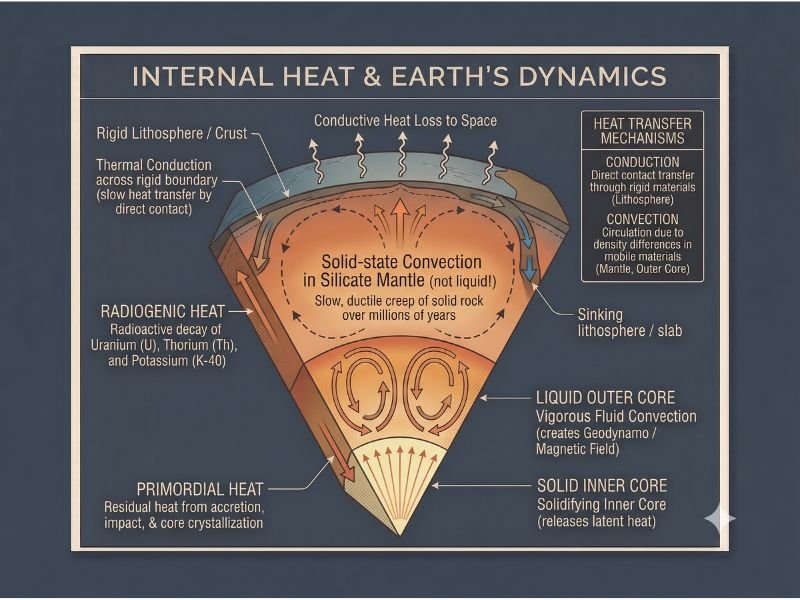
Where does Earth’s internal heat come from?
Primordial heat
Heat retained from planetary accretion, impacts, compression and early differentiation.
Radiogenic heat
Heat released by the radioactive decay of isotopes such as uranium, thorium and potassium in the Earth.
Additional energy is associated with ongoing core evolution, including the release of latent heat and compositional buoyancy during inner-core growth. These processes contribute to the energy budget of the geodynamo.
How does heat move?
| Process | Meaning | Example |
|---|---|---|
| Conduction | Heat transfer without bulk movement of material. | Heat transfer through solid rocks. |
| Convection | Heat transfer involving bulk movement of material. | Slow circulation of mantle rock over geological time. |
| Advection | Heat transported by the movement of a fluid or material. | Movement of magma carrying heat. |
Why can the inner core be solid?
Pressure rises enormously towards the centre of the Earth. The inner core remains predominantly solid despite its very high temperature because the pressure changes the conditions under which its iron-rich material melts.
Check your understanding
Which statement is correct?
UPSC Prelims practice quiz
Attempt each question before checking your answer. These are original practice questions designed to test conceptual understanding.
Question 1
Which of the following provides the strongest evidence for the liquid state of the Earth’s outer core?
Question 2
Consider the following statements about seismic waves:
1. P-waves can travel through solids and liquids.
2. S-waves can propagate through the liquid outer core as ordinary
shear waves.
3. Seismic-wave velocities depend on the physical properties of
the material.
Question 3
The Gutenberg discontinuity marks the boundary between:
Question 4
Which of the following is an indirect source of evidence about Earth’s interior?
Question 5
Why does a P-wave shadow zone form?
UPSC Mains answer-writing practice
Question 1 — 150 words
Explain how seismic waves help scientists infer the physical state and internal boundaries of the Earth.
Suggested time: 7 minutes
Suggested answer framework
- Introduction: Explain why direct investigation of the deep interior is limited.
- P-waves: Explain their ability to travel through solids and liquids, and how refraction reveals boundaries.
- S-waves: Explain their inability to propagate through the liquid outer core as ordinary shear waves.
- Discontinuities: Use the Moho, Gutenberg and Lehmann boundaries as examples.
- Conclusion: Explain how seismic observations support and refine models of Earth’s interior.
Question 2 — 250 words
Discuss the direct and indirect sources of evidence used to understand the Earth’s interior. Explain why seismic evidence is particularly important.
Suggested time: 11 minutes
Self-assessment checklist
One-minute final revision
Direct evidence: Rocks, mines, boreholes, volcanic material and exposed deep rocks.
Indirect evidence: Seismic waves, gravity, geomagnetism, heat flow, meteorites and laboratory experiments.
P-waves: Travel through solids and liquids.
S-waves: Do not propagate through the liquid outer core as ordinary shear waves.
P-wave shadow zone: Strong refraction at the core–mantle boundary.
Moho: Crust–mantle boundary.
Gutenberg: Mantle–outer-core boundary.
Lehmann: Outer-core–inner-core boundary in the standard introductory model.
