
Structure of the Earth
The Earth’s interior, seismic evidence and internal dynamics
What lies beneath the Earth’s surface?
The Earth is a differentiated planet with a layered interior. Its outer surface gives us direct evidence of rocks and landforms, but most of the interior cannot be examined directly. Geologists therefore combine indirect evidence—especially seismic waves—with observations from rocks, volcanic activity, gravity and the Earth’s magnetic field.

Why does this topic matter for UPSC?
Volcanism
Magma generation, mantle melting and movement of tectonic plates.
Earthquakes
Seismic waves reveal boundaries and physical properties inside Earth.
Geomagnetism
Movement of electrically conducting liquid metal in the outer core.
Plate tectonics
Interactions between lithospheric plates shape major landforms.
How do we know about the interior?
- Direct evidence: exposed rocks, deep mines, boreholes and material brought to the surface by volcanism.
- Seismic evidence: changes in the speed, direction and transmission of earthquake waves.
- Other evidence: gravity, average density, magnetic field, heat flow and meteorites.
Why are seismic waves more useful for investigating the deep interior than ordinary boreholes?
The major layers of the Earth
Earth’s mean radius is approximately 6,371 km. The compositional model divides the planet into the crust, mantle and core. The approximate depths below are useful for UPSC revision; the crust varies in thickness, and geological boundaries are not all perfectly uniform worldwide.
| Layer | Approximate depth | Key characteristics |
|---|---|---|
| Crust | Surface to Moho | Thin, solid outermost compositional layer; continental and oceanic crust differ. |
| Mantle | Moho to ~2,900 km | Silicate-rich material; predominantly solid but capable of slow deformation over geological time. |
| Outer core | ~2,900–5,150 km | Predominantly liquid iron alloy; important in generating Earth’s magnetic field. |
| Inner core | ~5,150–6,371 km | Predominantly solid iron alloy under immense pressure. |
Depth profile: learn the order
Check your understanding
Which layer extends from the Moho to approximately 2,900 km depth?
The crust and mantle
A. Continental and oceanic crust
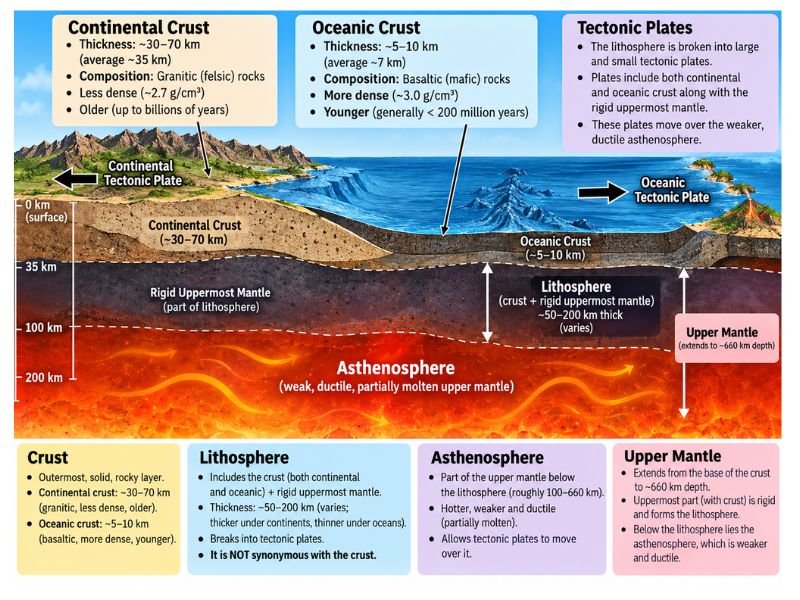
The crust is the Earth’s outermost compositional layer. Continental crust is generally thicker and less dense than oceanic crust. Oceanic crust is generally thinner and denser.
| Feature | Continental crust | Oceanic crust |
|---|---|---|
| Typical thickness | About 30–70 km; can vary | Usually about 5–10 km |
| General composition | Felsic to intermediate rocks are common | Predominantly basaltic and gabbroic rocks |
| Average density | Generally lower, roughly 2.7 g/cm³ | Generally higher, roughly 3.0 g/cm³ |
| Typical age | Can contain very ancient rocks | Generally much younger because of recycling |
The traditional SIAL and SIMA terminology
The Certificate Geography text uses the traditional terms SIAL for silica–alumina-rich continental material and SIMA for relatively silica–magnesium-rich, denser material associated with oceanic regions.
SIAL
Traditional textbook term; associated mainly with lighter, silica–alumina-rich continental crust.
SIMA
Traditional textbook term; associated mainly with denser, silica–magnesium-rich material.
B. The mantle
- Extends from the Moho to the core–mantle boundary at about 2,900 km depth.
- Composed predominantly of magnesium- and iron-bearing silicate minerals.
- Most of the mantle is solid; high temperature does not mean that the entire mantle is a liquid ocean of magma.
- Solid mantle rocks can deform and flow slowly over long geological periods.
- Mantle processes are closely related to plate motion, volcanism and heat transfer.
Why is oceanic lithosphere generally denser than continental lithosphere?
The outer core and inner core
The core occupies the deepest part of the Earth and is composed predominantly of iron alloy, with nickel and lighter elements. Its properties are inferred chiefly from seismic observations, together with density, magnetic and high-pressure evidence.
Outer core
- Approximately 2,900–5,150 km depth.
- Predominantly liquid metal.
- S-waves do not propagate through it as ordinary shear waves.
- Flow of electrically conducting material helps sustain the geodynamo and magnetic field.
Inner core
- Begins near 5,150 km depth.
- Extends to Earth’s centre at about 6,371 km.
- Predominantly solid iron alloy.
- Solid despite very high temperatures because of the enormous pressure.
Why is the inner core solid?
Temperature generally increases with depth, but physical state depends on both temperature and pressure. At the centre of the Earth, pressure is sufficiently high to stabilise solid iron-rich material under core conditions.
Three concepts to keep separate
| Temperature | Thermal state of material. |
|---|---|
| Pressure | Force exerted per unit area; increases greatly towards the centre. |
| Physical state | Depends on temperature, pressure and composition—not temperature alone. |
Which part of the Earth is most directly associated with generating the geomagnetic field?
Seismic waves: a window into the interior
Earthquakes release energy that travels through the Earth as seismic waves. Their speeds and paths change with the elastic properties, density and physical state of the materials through which they travel. These changes allow scientists to infer internal boundaries.
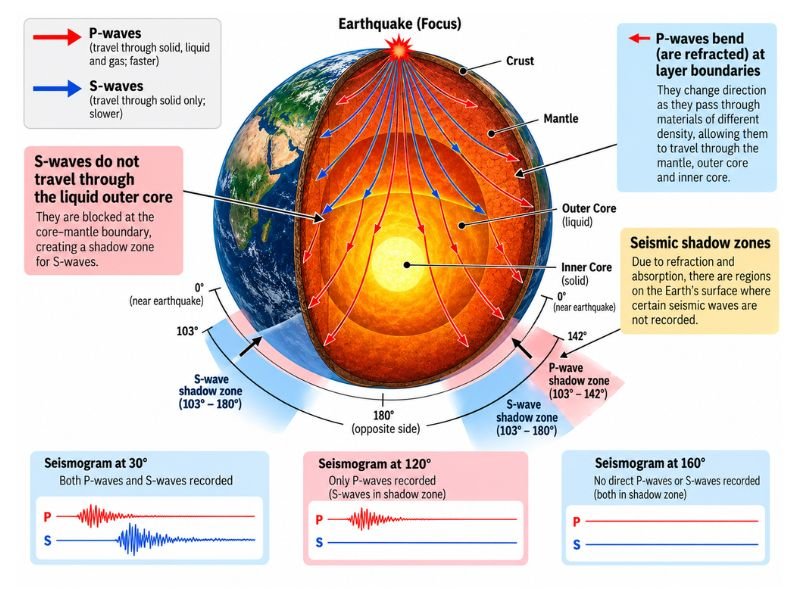
| Feature | P-waves | S-waves |
|---|---|---|
| Wave type | Compressional / longitudinal | Shear / transverse |
| Particle motion | Parallel to direction of travel | Perpendicular to direction of travel |
| Travel through solids | Yes | Yes |
| Travel through liquids | Yes | No, not as ordinary shear waves |
| Key UPSC inference | Refraction and velocity changes reveal boundaries | The global S-wave shadow supports the inference of a liquid outer core |
What do seismic observations tell us?
- Velocity changes: Abrupt changes indicate boundaries or changes in material properties.
- Refraction: Waves bend when their speeds change across materials.
- Shadow zones: Some regions receive no direct waves of a particular type because of the Earth’s internal structure and wave paths.
- S-wave absence through the outer core: Strong evidence that the outer core is liquid.
- P-wave behaviour: Refraction at the core–mantle boundary produces a prominent P-wave shadow zone.
Which seismic observation provides key evidence that the outer core is liquid?
Major seismic discontinuities
A seismic discontinuity is a boundary or transition at which seismic wave velocities change significantly. Some boundaries separate different compositions; others mark changes in mineral structure or physical properties.
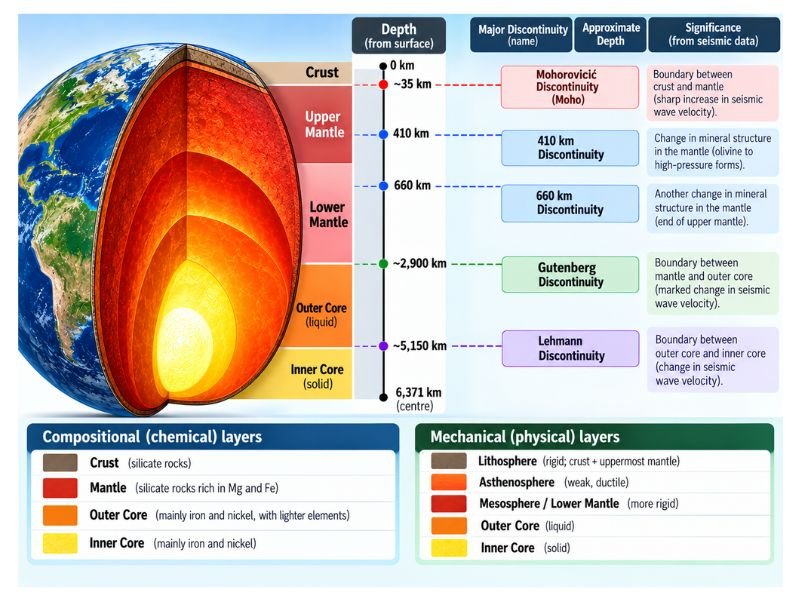
| Boundary | Approximate depth | Separates / marks |
|---|---|---|
| Mohorovičić (Moho) | Variable; often ~5–10 km beneath oceans and ~30–70 km beneath continents | Crust and mantle |
| 410 km discontinuity | ~410 km | Mineral phase transition in the upper mantle |
| 660 km discontinuity | ~660 km | Major transition towards the lower mantle |
| Gutenberg | ~2,900 km | Mantle and outer core |
| Lehmann | ~5,150 km | Outer core and inner core |
Moho → 410 → 660 → Gutenberg → Lehmann
Crust–mantle → upper-mantle transitions → lower mantle → liquid outer core → solid inner core.
Which discontinuity marks the boundary between the mantle and the outer core?
Two models of Earth’s internal structure
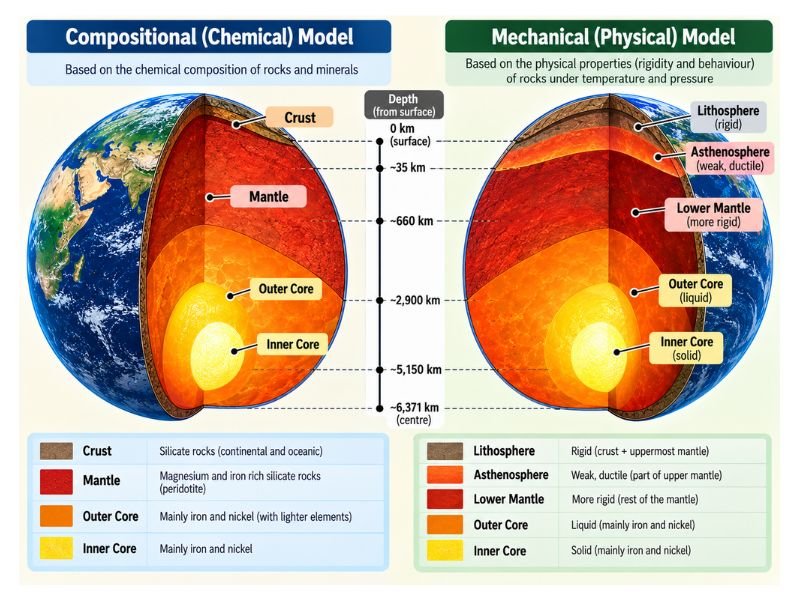
| Compositional model | Mechanical model |
|---|---|
| Crust | Part of the lithosphere |
| Mantle | Rigid uppermost mantle, asthenosphere, and deeper mantle regions |
| Core | Liquid outer core and solid inner core |
High-value UPSC facts
- The crust is not the same as the lithosphere.
- The lithosphere includes crust and rigid uppermost mantle.
- The asthenosphere is relatively weak and ductile; it is not necessarily a continuous global layer of liquid magma.
- The mantle is predominantly solid and deforms slowly.
- The outer core is liquid; the inner core is solid.
- P-waves travel through solids and liquids; S-waves do not propagate through the liquid outer core.
- Moho marks the crust–mantle boundary; Gutenberg marks the mantle–outer-core boundary; Lehmann marks the outer–inner-core boundary in the standard introductory model.
Common errors to avoid
UPSC Prelims practice quiz
Select an option for each question. The feedback explains the concept being tested. These are original practice questions, not reproduced UPSC previous-year questions.
Question 1
Which statement about the Earth’s mantle is correct?
Question 2
The Gutenberg discontinuity is associated with the boundary between:
Question 3
Which statement best explains the absence of ordinary S-waves through the outer core?
Question 4
The lithosphere comprises:
Question 5
Which statement about the inner core is correct?
UPSC Mains answer-writing practice
Question 1 — 150 words
Explain how seismic waves have helped scientists understand the internal structure of the Earth.
Suggested time: 7 minutes
Plan your answer before writing
- Introduction: Define the layered interior and explain why direct investigation is limited.
- Main body: Explain P-waves, S-waves, changes in velocity, refraction and shadow zones.
- Evidence: Link the absence of S-waves through the outer core to its liquid state; mention P-wave refraction.
- Conclusion: Show how seismic observations support a differentiated Earth with distinct internal boundaries.
Question 2 — 250 words
Distinguish between the compositional and mechanical classifications of the Earth’s interior. Explain their significance for understanding plate tectonics.
Suggested time: 11 minutes
Self-assessment checklist
One-minute final revision
Crust → Mantle → Outer core → Inner core
Moho → 410 km → 660 km → Gutenberg → Lehmann
P-waves: solids and liquids.
S-waves: do not propagate through the liquid outer core as shear waves.
Lithosphere: crust + rigid uppermost mantle.
