📖 UPSC Civil Services Exam
📚 Prelims – History – Mesolithic Age
🎥 Videos • 📄 Notes • 📝 Worksheets • ❓ MCQs
🕒 60–90 min

Mesolithic Age — UPSC Civil Services
Understanding the Mesolithic Age
The Mesolithic Age, or Middle Stone Age, represents a transitional phase between the Palaeolithic and Neolithic periods.
For UPSC, do not understand the Mesolithic merely as a period between two ages. It is important because it reflects significant changes in technology, subsistence, settlement patterns and human adaptation to changing environments.
Broad chronology
- In the Indian subcontinent, the Mesolithic is generally associated with approximately 10,000 BCE to 6,000 BCE, although the chronology varies considerably across regions.
- Some Mesolithic traditions continued much later in certain parts of India.
- The period broadly follows the Palaeolithic and precedes or overlaps with the emergence of Neolithic communities in different regions.
Palaeolithic → Mesolithic → Neolithic
Hunter-gatherers → More diversified hunter-gatherers → Food-producing communities
This was not a sudden or uniform transition. Different regions followed different trajectories.
Why Did the Mesolithic Emerge?
The Mesolithic developed in the context of major environmental changes following the end of the last Ice Age.
Major changes
- Climate became generally warmer and more stable. Forests, grasslands and wetlands expanded or changed in different regions.
- New varieties of plants and animals became available.
- Human communities adapted their subsistence strategies to these changing environments.
This led to:
- Greater exploitation of small animals and birds
- Increased fishing and aquatic-resource use in some regions
- Greater dependence on locally available plants
- More diversified food resources
- Changes in mobility and settlement
The Mesolithic is therefore closely associated with adaptation and diversification, rather than simply with a new type of stone tool.
Microliths — The Most Important Feature
The microlith is one of the most important archaeological indicators of the Mesolithic.
What are microliths?
Microliths are very small stone tools, often geometric in shape, which could be used individually or fitted into composite tools.
Common forms include:
- Triangles
- Trapezes
- Lunates
- Points
- Small blades
-
Composite tools
Microliths could be inserted into:
- Wooden handles
- Bone shafts
- Arrows
- Spears
- Other composite implements
This made relatively small pieces of stone highly effective.
Materials
Microliths were often made from fine-grained materials such as:
Why are microliths important?
Mesolithic = Microlithic technology + diversified subsistence + changing settlement patterns
However, microliths are not exclusively limited to the Mesolithic.
Microlithic technologies continued into later periods and may occur alongside early food production in some regions.
Economy & Subsistence
Mesolithic communities were still predominantly hunter-gatherers, but their subsistence became more diversified.
Hunting
People hunted:
The exact range of animals varied according to the environment.
Fishing
Fishing became increasingly important in communities living near:
Evidence includes fish bones and fishing-related remains at some sites.
Gathering
People collected:
Compared with earlier Palaeolithic communities, Mesolithic groups often exploited a wider range of smaller animals, plants and aquatic resources. This is sometimes described as
broad-spectrum subsistence
.Beginning of Animal Domestication
Evidence from some Mesolithic sites suggests an increasing relationship between humans and animals.
Important example
Bagor, Rajasthan provides evidence of a Mesolithic settlement with substantial animal remains and is important for understanding prehistoric subsistence and animal exploitation.
At some sites, evidence has been interpreted as indicating early stages of animal domestication.
Do not assume:
Mesolithic = fully developed domestication.
The transition from hunting wild animals to systematic animal domestication was gradual and regionally varied.
Settlement Patterns
Mesolithic communities generally remained mobile or semi-mobile, but there is evidence of increasing settlement stability at some sites.
Features
- Temporary camps
- Seasonal settlements
- Repeated occupation of favourable locations
- Greater use of rivers, lakes and other resource-rich environments
- Some evidence of more permanent or semi-permanent settlements
Why did people return to particular places?
Ans: Locations with abundant:
Water, Fish, Game, Plants and Stone resources
could support repeated occupation.
The Mesolithic should not be understood as a complete shift from: Nomadic → Permanent Instead, there was a continuum of mobility, varying according to environment and resource availability.
Burials & Social Practices
Burial evidence provides important information about Mesolithic communities.
Some Mesolithic sites contain:
Human burialsIndividual graves
Multiple burials
Grave goods in certain contexts
Why are burials important?
They help archaeologists study:Mortuary practices, Diet, Health, Demography, Social relationships, Beliefs and symbolic behaviour.
Important Site
Sarai Nahar Rai, Uttar Pradesh is particularly important for Mesolithic burials.Other important sites with burial evidence include: Mahadaha Damdama All are located in the Ganga Valley region of Uttar Pradesh.
Mesolithic Rock Art
The Mesolithic period is particularly important for understanding prehistoric art in India.
Bhimbetka
The Bhimbetka rock shelters in Madhya Pradesh contain extensive prehistoric paintings.Common themes include:
Animals, Hunting, Human figures, Group activities, Dancing, Everyday life.
What can rock art tell us?
It provides clues about:- Hunting practices
- Animals known to communities
- Social activities
- Symbolic expression
- Possible ritual practices
Not all paintings at Bhimbetka are Mesolithic. The rock-art sequence covers multiple periods, from prehistoric phases to later historical times.
Important Mesolithic Sites in India
Bagor — Rajasthan
– Located near the Kothari River.
– One of the important Mesolithic sites of western India.
– Provides evidence of hunter-gatherer occupation.
– Important for studying animal exploitation and subsistence.
Langhnaj — Gujarat
– Important Mesolithic site.
– Provides evidence of human occupation and burials.
– Associated with microlithic technology.
Sarai Nahar Rai — Uttar Pradesh
– Important Mesolithic site in the Ganga Valley.
– Known particularly for human burials.
– Provides evidence about the biological and social characteristics of Mesolithic populations.
Mahadaha — Uttar Pradesh
– Important Mesolithic site.
– Human burials have been discovered.
– Provides evidence for diet, subsistence and mortuary practices.
You will find a few more sites in the next page.
Important Mesolithic Sites in India
Damdama — Uttar Pradesh
– Important Mesolithic settlement.
– Known for human burials and evidence of prehistoric life.
Bhimbetka — Madhya Pradesh
– Famous for prehistoric rock shelters and paintings.
– Contains evidence belonging to several prehistoric periods, including Mesolithic contexts.
Adamgarh — Madhya Pradesh
– Important prehistoric site.
– Provides evidence of Mesolithic occupation and rock art.
Understanding the geographical map of India will help us remember the sites and understand the spread in a better way.
Map
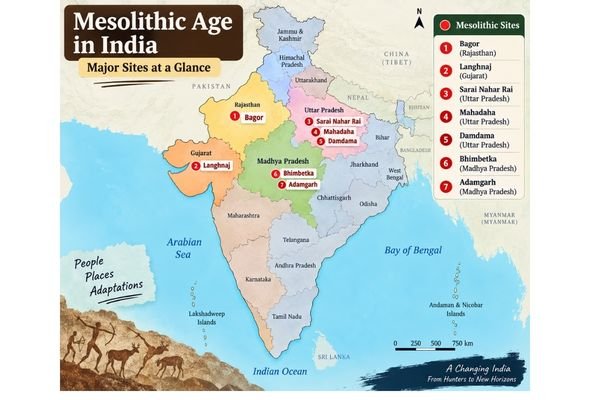
Practice on your map book.
Mesolithic Sites — Quick Revision Table
| Site | State | Key Importance |
|---|---|---|
| Bagor | Rajasthan | Mesolithic settlement and subsistence |
| Langhnaj | Gujarat | Microliths and burials |
| Sarai Nahar Rai | Uttar Pradesh | Mesolithic burials |
| Mahadaha | Uttar Pradesh | Burials and subsistence evidence |
| Damdama | Uttar Pradesh | Settlement and burials |
| Bhimbetka | Madhya Pradesh | Rock shelters and prehistoric art |
| Adamgarh | Madhya Pradesh | Mesolithic occupation and rock art |
Practice above on the geographical map of India.
Mesolithic Art & Culture
Mesolithic art provides evidence of increasingly complex social and symbolic behaviour.
Common subjects:
Hunting, Animals, Dancing, Group activities, Human figures, Everyday activities.
What makes the art significant?
It helps us move beyond studying prehistoric people only through their tools.Through art, archaeologists can investigate:
Social interaction, Hunting practices, Symbolic behaviour, Human-animal relationships, Possible ritual activities.
However, Interpretations of prehistoric art must be made cautiously because its precise meaning cannot always be established.
Technology Beyond Stone
Although stone tools remain the most visible archaeological evidence, Mesolithic communities also used other materials.
Possible materials included:
- Bone
- Wood
- Animal hide
- Plant fibres
Why do we know less about these?
Organic materials generally decay more easily than stone.Therefore: Archaeological visibility does not necessarily represent the complete technological system of Mesolithic communities.
This is an important conceptual point for advanced UPSC questions.
Palaeolithic vs Mesolithic vs Neolithic
| Feature | Palaeolithic | Mesolithic | Neolithic |
|---|---|---|---|
| Meaning | Old Stone Age | Middle Stone Age | New Stone Age |
| Economy | Hunting & gathering | Diversified hunting, gathering, fishing | Agriculture & food production increasingly important |
| Tools | Large/chipped tools | Microliths | Polished stone tools |
| Mobility | Generally high | Mobile to semi-mobile | Increasing settlement |
| Agriculture | Absent | Limited/incipient in some contexts | Established in many regions |
| Domestication | Generally absent | Emerging in some contexts | Widespread in many regions |
| Art | Present in prehistoric contexts | Important rock-art traditions | Pottery, crafts and other developments |
| Settlement | Temporary/mobile | Seasonal and repeated occupations | Increasingly permanent |
focus on these ideas:
The Most Important Concepts for UPSC
1. Microliths
Small stone tools are the most recognisable technological feature.2. Environmental Adaptation
Changing post-Ice Age environments encouraged new subsistence strategies.3. Diversified Economy
Hunting continued, but fishing, gathering and exploitation of smaller animals became increasingly important.4. Changing Mobility
Communities remained mobile in many regions, but some repeatedly occupied resource-rich locations.5. Burials
Sites such as Sarai Nahar Rai, Mahadaha and Damdama provide important evidence.6. Rock Art
Bhimbetka is crucial for understanding prehistoric art, but its paintings belong to multiple periods.When revising the Mesolithic Age, focus on these six ideas:
UPSC & State PSCs Prelims — Site-Based Facts
Bagor → Rajasthan → Mesolithic settlement
Langhnaj → Gujarat → Mesolithic evidence
Sarai Nahar Rai → Uttar Pradesh → Burials
Mahadaha → Uttar Pradesh → Burials
Damdama → Uttar Pradesh → Burials
Bhimbetka → Madhya Pradesh → Rock shelters and prehistoric art
Adamgarh → Madhya Pradesh → Mesolithic occupation and rock art
Remember these associations:
Ready to Test Yourself?
You’ve completed the learning part—now it’s time to see what you remember. Don’t worry about getting everything right. These MCQs are here to help you identify what you know and what needs a little more attention.
8–10 correct: Great work! You’re ready to move forward.
5–7 correct: Good progress. Quickly revise the areas where you made mistakes, then continue.
0–4 correct: No problem at all. Revisit the topic once more, focus on the key concepts and sites, and try the MCQs again.
Remember: Your score is not the goal—improving your understanding is. Keep learning, keep revising, and move forward with confidence.