
📖 UPSC Civil Services Exam
📚 Prelims – History – Palaeolithic Age
🎥 Videos • 📄 Notes • 📝 Worksheets • ❓ MCQs
🕒 60–90 minutes


Food & Subsistence
Palaeolithic communities were primarily hunter-gatherers.
Hunting
Gathering
People collected:Tools & Technology
| Phase | Characteristic Tools |
|---|---|
| Lower Palaeolithic | Handaxes, cleavers, choppers |
| Middle Palaeolithic | Flakes, scrapers, points |
| Upper Palaeolithic | Blades, burins, specialised tools |
Raw materials
Commonly used materials included:Other locally available stones.
Changes in tool technology help archaeologists distinguish different Palaeolithic phases.
Map
Settlement & Environment
- People generally lived in small, mobile groups. They moved in search of water, food and suitable habitats.
- River valleys, rock shelters and areas close to raw-material sources were important.
- Permanent villages and agricultural settlements had not yet developed.
- Caves and rock shelters were used where suitable, but Palaeolithic people did not necessarily live exclusively in caves.
Discovery & Use of Fire
Fire was an important technological development in prehistoric human life.
- Cooking food
- Providing warmth
- Protection from animals
- Light
- Processing certain materials
Possible uses:-
Art & Symbolic Expression
The prehistoric record provides evidence of symbolic behaviour and artistic expression, particularly in later prehistoric contexts.
Bhimbetka rock shelters are especially important for Indian prehistoric art.
Paintings depict subjects such as:
- Animals
- Hunting scenes
- Human figures
- Group activities
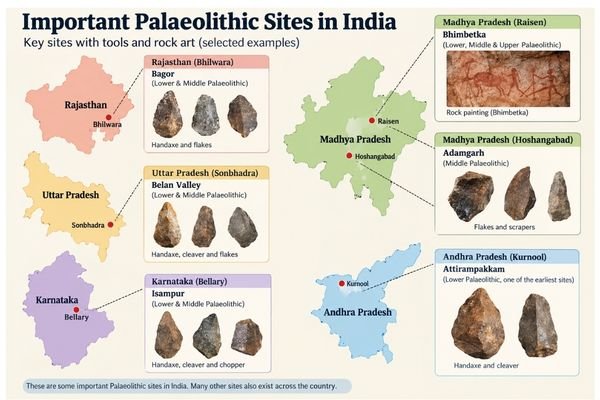
Important Palaeolithic Sites — India
| Site | State / Region | Importance |
|---|---|---|
| Attirampakkam | Tamil Nadu | Early Lower Palaeolithic / Acheulian evidence |
| Isampur | Karnataka | Stone-tool manufacturing site |
| Hunsgi Valley | Karnataka | Extensive Palaeolithic evidence |
| Narmada Valley | Madhya Pradesh region | Tools and hominin fossil evidence |
| Bhimbetka | Madhya Pradesh | Palaeolithic occupation; extensive rock shelters and later rock art |
| Didwana | Rajasthan | Palaeolithic evidence |
| Nevasa | Maharashtra | Palaeolithic cultural sequence |
| Patne | Maharashtra | Upper Palaeolithic evidence |
| Kurnool Caves | Andhra Pradesh | Palaeolithic occupation and prehistoric evidence |
Palaeolithic vs Neolithic
| Palaeolithic | Neolithic |
|---|---|
| Old Stone Age | New Stone Age |
| Hunting & gathering | Agriculture and food production |
| Highly mobile communities | Increasingly settled communities |
| Mainly chipped stone tools | Polished stone tools become characteristic |
| No systematic agriculture | Agriculture established |
| No domesticated-crop-based economy | Cultivation and animal domestication |
| Temporary/seasonal habitation common | Permanent settlements increasingly common |
Exam Focus – Why the Palaeolithic Age Matters for UPSC & PCS Exams
Remember the Palaeolithic Age through five themes:
- Technology → Stone tools and changing tool-making techniques
- Economy → Hunting and gathering
- Society → Small, mobile communities
- Environment → Adaptation to different landscapes and resources
- Archaeology → Tools, fossils, habitation sites, rock shelters and art
Quick Revision – Palaeolithic Age
As you revise the Palaeolithic Age, remember it as the beginning of human technological and cultural development. It was characterised by hunting, gathering, mobility and stone-tool technology.
In India, it is broadly divided into Lower, Middle and Upper Palaeolithic phases, reflected in changing tool types—from handaxes and cleavers to flakes, scrapers, points and blades.
Important sites include Attirampakkam, Hunsgi, Isampur, Narmada Valley, Bhimbetka, Didwana and Patne.
Focus on the connection between technology, environment, subsistence and human adaptation.
UPSC Core Framework: Tools + Sites + Chronology + Lifestyle
Test Yourself — Check Your Understanding
Check Your Progress
Now you are ready to attempt the MCQs below. If you score:
60% or above?
Great! You have a good grasp of the basic concepts.
Keep revising and move on to the next topic.
Below 60%?
No problem! Go back to the sections where you made mistakes,
review the key concepts, and try the MCQs again.
Remember
Every mistake is a clue about what to revise.
The goal is not just to get the answer right — it is to understand why it is right.

Leave a Reply