
Structure of Atom
In-Text Question Answers
Page 39 – Questions & Answers
Question 1. What are canal rays?
Answer:
Canal rays are streams of positively charged particles produced in a gas discharge tube.
They were discovered by E. Goldstein and are also called positive rays.
Question 2. If an atom contains one electron and one proton, will it carry any charge or not?
Answer:
No, the atom will not carry any charge.
Reason:
-
Electron has a charge of –1
-
Proton has a charge of +1
-
These charges are equal and opposite, so they cancel each other
Hence, the atom is electrically neutral.
Page 41 – Set 1 (After Bohr’s Model of Atom)
Question 1. On the basis of Thomson’s model of an atom, explain how the atom is neutral as a whole.
Answer:
According to Thomson’s model, an atom consists of a positively charged sphere with negatively charged electrons embedded in it.
The total positive charge is equal to the total negative charge of electrons, therefore the atom as a whole is electrically neutral.
Question 2. On the basis of Rutherford’s model of an atom, which sub-atomic particle is present in the nucleus of an atom?
Answer:
According to Rutherford’s model, the nucleus contains positively charged particles called protons.
Question 3. Draw a sketch of Bohr’s model of an atom with three shells.
Answer (description for exam):
Bohr’s model shows:
-
A central nucleus
-
Three circular shells around it named K, L, and M
-
Electrons revolving in these fixed shells
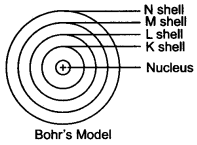
Question 4. What do you think would be the observation if the α-particle scattering experiment is carried out using a foil of a metal other than gold?
Answer:
Similar observations would be obtained, but the extent of deflection may vary because:
-
Gold is extremely thin and malleable
-
Other metals are less malleable, so fewer α-particles may pass through without deflection
Page 41 – Set 2 (After Neutrons)
Question 1.
Name the three sub-atomic particles of an atom.
Answer:
The three sub-atomic particles are:
-
Electrons
-
Protons
-
Neutrons
Question 2.
Helium atom has an atomic mass of 4 u and two protons in its nucleus. How many neutrons does it have?
Answer:
Mass number = Protons + Neutrons
Helium atom has 2 neutrons.
Page 42 – Questions & Answers
Question 1. Write the distribution of electrons in carbon and sodium atoms.
Carbon (Atomic number = 6):
-
K shell = 2 electrons
-
L shell = 4 electrons
Electronic configuration of carbon = 2,4
Sodium (Atomic number = 11):
-
K shell = 2 electrons
-
L shell = 8 electrons
-
M shell = 1 electron
Electronic configuration of sodium = 2,8,1
Question 2. If K and L shells of an atom are full, then what would be the total number of electrons in the atom?
-
Maximum electrons in K shell = 2
-
Maximum electrons in L shell = 8
Total number of electrons = 10
Page 44 – Second Set of Questions
Question 1.
If the number of electrons in an atom is 8 and the number of protons is also 8, then
(i) what is the atomic number of the atom?
(ii) what is the charge on the atom?
Answer:
(i) Atomic number = number of protons = 8
(ii) Charge on the atom = 0
Reason: Number of electrons (–8) = number of protons (+8), so charges cancel out.
The atom is electrically neutral.
Question 2.
With the help of Table 4.1, find out the mass number of oxygen and sulphur atom.
Answer:
-
Oxygen atom
Protons = 8, Neutrons = 8 -
Sulphur atom
Protons = 16, Neutrons = 16
Page 45 – Questions & Answers
Question 1. For the symbols H, D and T, tabulate three sub-atomic particles found in each of them.
Answer:
| Isotope | Protons | Neutrons | Electrons |
|---|---|---|---|
| H (Protium) | 1 | 0 | 1 |
|
D (Deuterium) |
1 | 1 | 1 |
| T (Tritium) | 1 | 2 | 1 |
Question 2. Write the electronic configuration of any one pair of isotopes and isobars.
(a) Isotopes (example: Chlorine)
Isotopes have the same atomic number, so their electronic configuration is the same.
-
Chlorine-35 (³⁵₁₇Cl): 2, 8, 7
-
Chlorine-37 (³⁷₁₇Cl): 2, 8, 7
(b) Isobars (example: Calcium and Argon)
Isobars have the same mass number but different atomic numbers, so their electronic configuration is different.
-
Calcium-40 (⁴⁰₂₀Ca): 2, 8, 8, 2
-
Argon-40 (⁴⁰₁₈Ar): 2, 8, 8
