
Exercises – Chapter 6: Tissues
Question 1
Define the term “tissue”.
Answer:
A tissue is a group of similar cells having a common origin that work together to perform a specific function.
Question 2
How many types of elements together make up the xylem tissue? Name them.
Answer:
Xylem tissue is made up of four types of elements:
-
Tracheids
-
Vessels
-
Xylem fibres
-
Xylem parenchyma
Question 3
How are simple tissues different from complex tissues in plants?
Answer:
| Simple Tissues | Complex Tissues |
|---|---|
| Made of one type of cell | Made of more than one type of cell |
| Perform basic functions |
Perform complex functions like transport |
|
Example: Parenchyma, Collenchyma, Sclerenchyma |
Example: Xylem, Phloem |
Question 4
Differentiate between parenchyma, collenchyma and sclerenchyma on the basis of their cell wall.
Answer:
| Tissue | Cell wall |
|---|---|
| Parenchyma | Thin cell wall |
| Collenchyma |
Unevenly thickened at corners |
| Sclerenchyma | Very thick, lignified cell wall |
Question 5
What are the functions of the stomata?
Answer:
Functions of stomata:
-
Exchange of gases (O₂ and CO₂)
-
Transpiration (loss of water vapour)
-
Regulation of water balance in plants
Question 6
Diagrammatically show the difference between the three types of muscle fibres.
Answer (what to draw in exam):
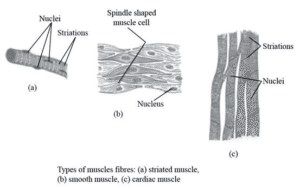
-
Striated muscle:
Long, cylindrical fibres with alternate light and dark bands, many nuclei. -
Unstriated muscle:
Spindle-shaped fibres, no striations, single nucleus. -
Cardiac muscle:
Branched fibres with striations, single nucleus, connected by intercalated discs.
Question 7
What is the specific function of the cardiac muscle?
Answer:
The cardiac muscle contracts rhythmically and continuously to pump blood throughout the body.
Question 8
Differentiate between striated, unstriated and cardiac muscles on the basis of their structure and site/location in the body.
Answer:
| Feature | Striated | Unstriated | Cardiac |
|---|---|---|---|
| Striations | Present | Absent | Present |
| Control | Voluntary |
Involuntary |
Involuntary |
| Shape |
Long, cylindrical |
Spindle-shaped | Branched |
| Location | Limbs |
Stomach, intestine |
Heart |
Question 9
Draw a labelled diagram of a neuron.
Answer (what to draw):
-
Dendrites
-
Cell body (cyton)
-
Nucleus
-
Axon
-
Axon terminal
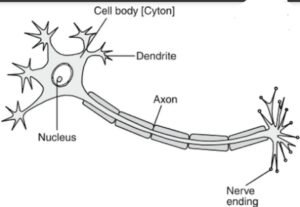
(Draw a neat neuron and label all parts clearly.)
Question 10
Name the following:
(a) Tissue that forms the inner lining of our mouth
→ Squamous epithelium
(b) Tissue that connects muscle to bone in humans
→ Tendon
(c) Tissue that transports food in plants
→ Phloem
(d) Tissue that stores fat in our body
→ Adipose tissue
(e) Connective tissue with a fluid matrix
→ Blood
(f) Tissue present in the brain
→ Nervous tissue
Question 11
Identify the type of tissue in the following:
| Structure | Tissue |
|---|---|
| Skin | Squamous epithelium |
| Bark of tree |
Protective tissue |
| Bone |
Connective tissue |
| Lining of kidney tubule |
Cuboidal epithelium |
| Vascular bundle |
Complex permanent tissue |
Question 12
Name the regions in which parenchyma tissue is present.
Answer:
Parenchyma tissue is present in:
-
Cortex and pith of stems and roots
-
Mesophyll of leaves
-
Fleshy parts of fruits
-
Seeds and endosperm
Question 13
What is the role of epidermis in plants?
Answer:
The epidermis forms the outer protective layer of plants. Its main roles are:
-
Protection from mechanical injury and infection
-
Prevention of water loss by cuticle
-
Gas exchange through stomata
-
Absorption of water and minerals in roots (root hairs)
Question 14
How does the cork act as a protective tissue?
Answer:
Cork acts as a protective tissue because:
-
Its cells are dead and tightly packed
-
Cell walls are coated with suberin, which makes them impermeable to water and gases
-
It protects the plant from water loss, pathogens, and mechanical damage
Question 15
Complete the following chart:
| Tissue | Location | Function |
|---|---|---|
| Areolar tissue | Between skin and muscles |
Packing, binding and support |
| Adipose tissue | Below skin, around organs | Storage of fat, insulation |
| Bone | Skeleton |
Support, protection, movement |
| Tendon | Between muscle and bone | Attaches muscle to bone |
| Blood | Blood vessels |
Transport of gases, food, wastes |
