
Go back to UGC NET COMUPTER SCIENCE
UNIT – 1 : DISCRETE STRUCTURES & LOGIC
Mathematical Logic
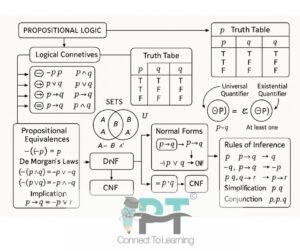
(Complete Conceptual Notes)
PART A — MATHEMATICAL LOGIC
1. PROPOSITIONAL LOGIC
1.1 What is a Proposition?
A proposition is a declarative sentence that expresses a fact and has a definite truth value:
either True (T) or False (F), but never both at the same time.
✔ Examples of Propositions (Meaningful Facts)
-
“7 is a prime number.” → True
-
“The Earth has two moons.” → False
✘ Not Propositions (No truth value / not a statement of fact)
-
“Shut the door.” (command)
-
“Where are you?” (question)
-
“x is greater than 10.” (truth depends on x → open sentence)
Why important?
Because logic operates only on propositions with fixed truth values.
1.2 Propositional Variables
We use letters like p, q, r to represent propositions.
Example:
-
Let p = “It is raining.”
-
Let q = “The ground is wet.”
2. LOGICAL CONNECTIVES WITH STATEMENTS
Connectives combine propositions to form compound statements.
2.1 Negation (¬p)
Statement Form:
“NOT p” means that whatever p asserts, the negation asserts the opposite.
Example:
-
p = “The sky is blue.”
-
¬p = “The sky is not blue.”
Truth rule:
-
If p is true → ¬p is false
-
If p is false → ¬p is true
2.2 Conjunction (p ∧ q)
Statement Form:
“p AND q” means both statements must be true simultaneously.
Example:
-
p: “The power is on.”
-
q: “The fan is running.”
-
p ∧ q: “The power is on and the fan is running.”
2.3 Disjunction (p ∨ q)
Statement Form:
“p OR q” means at least one of the two statements must be true.
Example:
-
p: “I will study.”
-
q: “I will watch a movie.”
-
p ∨ q: “I will study or watch a movie (or both).”
2.4 Implication (p → q)
Statement Form:
“If p is true, then q must also be true.”
Example:
-
p: “It rains.”
-
q: “The ground gets wet.”
-
p → q: “If it rains, then the ground gets wet.”
Exception:
If it does NOT rain, the statement is considered true regardless of the ground’s condition.
2.5 Biconditional (p ↔ q)
Statement Form:
“p is true if and only if q is true.”
Example:
-
p: “You pass the course.”
-
q: “You score ≥ 40.”
-
p ↔ q: “You pass the course if and only if you score ≥ 40.”
True when both p and q have the same truth value.
3. TRUTH TABLES (Purpose + Use)
Truth tables allow us to compute the truth value of compound propositions under all possible combinations.
4. PROPOSITIONAL EQUIVALENCES
Logical equivalences indicate when two compound statements always have the same truth value.
4.1 Double Negation
Statement:
“Saying ‘NOT NOT p’ means the same as saying p.”
Symbolically:
¬(¬p) ≡ p
4.2 De Morgan’s Laws
These describe how negation interacts with AND/OR.
Statements:
-
“The negation of ‘p AND q’ is the same as ‘NOT p OR NOT q’.”
-
“The negation of ‘p OR q’ is the same as ‘NOT p AND NOT q’.”
4.3 Implication Law
Statement:
“‘If p then q’ is equivalent to saying ‘Either p is false OR q is true.’”
p → q ≡ ¬p ∨ q
This is core to CNF/DNF.
4.4 Contrapositive (Key Logical Principle)
Statement:
“‘If p then q’ is logically equivalent to ‘If NOT q then NOT p’.”
4.5 Biconditional Law
Statement:
“‘p if and only if q’ means both ‘if p then q’ AND ‘if q then p’ must be true.”
5. NORMAL FORMS (CNF, DNF)

5.1 Disjunctive Normal Form (DNF)
Statement:
A formula is in DNF when it is expressed as an OR of AND terms.
Example Statement:
“p AND q is true OR p is false AND r is true.”
Symbolic:
(p ∧ q) ∨ (¬p ∧ r)
5.2 Conjunctive Normal Form (CNF)
Statement:
A formula is in CNF when it is expressed as an AND of OR terms.
Example Statement:
“Either p or q is true AND either p or r is true.”
Symbolic:
(p ∨ q) ∧ (p ∨ r)
PART B — PREDICATE LOGIC
6. PREDICATES
A predicate is an expression involving variables that becomes a proposition when specific values are substituted.
Example:
P(x): “x is divisible by 3.”
— P(6) is True
— P(7) is False
7. QUANTIFIERS
7.1 Universal Quantifier (∀)
Statement Meaning:
“∀x P(x)” means “For every x, P(x) is true.”
Example Statement:
“Every natural number is greater than or equal to 0.”
7.2 Existential Quantifier (∃)
Statement Meaning:
“∃x P(x)” means “There exists at least one x such that P(x) is true.”
Example Statement:
“There exists a number divisible by 6.”
8. NESTED QUANTIFIERS

Example 1
∀x ∃y P(x,y)
Statement Meaning:
“For every x, there exists a y such that P(x,y) holds.”
Example in math:
“For every number x, there is a number y greater than x.”
Example 2
∃y ∀x P(x,y)
Statement Meaning:
“There exists a single y such that for every x, P(x,y) holds.”
Example:
“There is one number y greater than all numbers x.”
→ False (no largest integer)
9. NEGATION OF QUANTIFIERS (WITH EXPLANATORY STATEMENTS)
Universal to Existential
¬∀x P(x)
Statement:
“It is NOT true that P(x) holds for all x”
⟹ “There exists at least one x for which P(x) does not hold.”
Existential to Universal
¬∃x P(x)
Statement:
“It is NOT true that there exists an x with P(x)”
⟹ “For every x, P(x) is false.”
10. RULES OF INFERENCE (WITH NATURAL LANGUAGE MEANINGS)
10.1 Modus Ponens
p, and p → q
Statement Meaning:
“If p is true, and p implies q, then q must be true.”
10.2 Modus Tollens
¬q, and p → q
Statement Meaning:
“If q is false, and p implies q, then p must be false.”
10.3 Hypothetical Syllogism
p → q, q → r
Statement Meaning:
“If p implies q, and q implies r, then p implies r.”
10.4 Simplification
p ∧ q
→ p
Statement:
“If both p and q are true, then p is true.”
10.5 Addition
p
→ p ∨ q
Statement:
“If p is true, then ‘p OR q’ is automatically true.”
10.6 Conjunction
p, q
→ p ∧ q
Statement:
“If p is true and q is true, then ‘p AND q’ is true.”
