
Mechanical Properties of Solids
Question 8.1
A steel wire of length 4.7 m and cross-sectional area 3.0 × 10⁻⁵ m² stretches by the same amount as a copper wire of length 3.5 m and cross-sectional area 4.0 × 10⁻⁵ m² when both are subjected to the same load. Find the ratio of the Young’s modulus of steel to that of copper.
Solution
For a wire under tension, the extension is given by:
Since both wires experience the same load and same extension,
Cancelling and rearranging,
Substituting values:
Question 8.2
Figure 8.9 shows the stress–strain curve for a given material.
Find:
-
Young’s modulus of the material, and
-
Approximate yield strength.
Understanding the Graph (Figure 8.9)
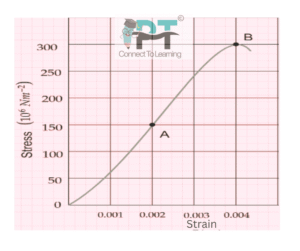
-
X-axis: Strain (dimensionless)
-
Y-axis: Stress (in MPa)
-
The curve is linear initially and then bends after a point.
The linear portion obeys Hooke’s law and its slope gives Young’s modulus.
The point where the curve deviates from linearity gives the yield strength.
(a) Young’s Modulus
From the straight-line portion of the graph (approximate reading):
-
Stress ≈ 150 MPa
-
Corresponding strain ≈ 0.002
Young’s Modulus
(b) Approximate Yield Strength
-
Yield point is where the curve starts deviating from linearity
-
From the graph, this occurs at stress ≈ 250 MPa
Yield Strength
Question 8.3
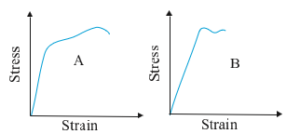
The stress–strain graphs for materials A and B are shown in Fig. 8.10.
The graphs are drawn to the same scale.
(a) Which of the materials has the greater Young’s modulus?
(b) Which of the two is the stronger material?
Solution
Key Concepts Used
-
Young’s Modulus (Y)
-
Equal to the slope of the linear (elastic) part of the stress–strain curve.
-
Steeper slope ⇒ larger Young’s modulus.
-
-
Strength of a Material
-
Determined by the maximum stress the material can withstand before breaking.
-
Higher maximum stress ⇒ stronger material.
-
(a) Greater Young’s Modulus
-
From Fig. 8.10, material B has a steeper initial (linear) portion of the stress–strain curve than material A.
-
Since:
a steeper slope means larger Young’s modulus.
Answer (a):
(b) Stronger Material
-
Strength depends on the maximum stress reached before fracture.
-
From the graph, material A can withstand a higher stress before breaking than material B.
Answer (b):
Question 8.4
Read the following statements carefully and state, with reasons, whether they are true or false:
(a) The Young’s modulus of rubber is greater than that of steel.
(b) The stretching of a coil is determined by its shear modulus.
Solution
(a) The Young’s modulus of rubber is greater than that of steel.
❌ False
Reason:
-
Young’s modulus is a measure of stiffness (resistance to deformation).
-
Rubber stretches much more than steel for the same applied force.
-
Hence, rubber has a much smaller Young’s modulus compared to steel.
Conclusion:
Steel is more elastic (stiffer) than rubber, even though rubber stretches more.
(b) The stretching of a coil is determined by its shear modulus.
✅ True
Reason:
-
When a coil (spring) is stretched, the wire forming the coil undergoes shearing deformation, not longitudinal stretching.
-
Therefore, the restoring force and extension of a coil depend on the shear modulus (modulus of rigidity) of the material.
Question 8.5
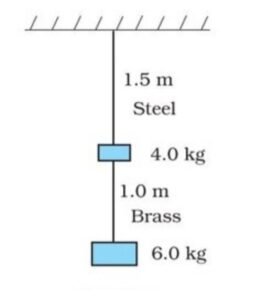
Two wires of equal diameter 0.25 cm, one made of steel and the other of brass, are loaded as shown in Fig. 8.11. The unloaded length of the steel wire is 1.5 m and that of the brass wire is 1.0 m.
Calculate the elongations of the steel wire and the brass wire.
(Young’s modulus: Steel = ,
Brass = )
Solution
Given
Diameter of each wire:
Radius:
Cross-sectional area:
Lengths:
-
Steel wire:
-
Brass wire:
Young’s modulus:
-
Steel:
-
Brass:
Load on each wire (from Fig. 8.11):
Formula Used
(a) Elongation of Steel Wire
(b) Elongation of Brass Wire
Question 8.7
Four identical hollow cylindrical columns of mild steel support a big structure of mass 50,000 kg. The inner radius of each column is 30 cm and the outer radius is 60 cm. Assuming that the load is uniformly distributed, calculate the compressional strain of each column.
(Young’s modulus of mild steel = ;
take )
Solution
Step 1: Total load on the structure
Since there are four identical columns, load on each column:
Step 2: Cross-sectional area of one hollow column
Outer radius:
Inner radius:
Step 3: Stress on each column
Step 4: Compressional strain
Question 8.8
A piece of copper having a rectangular cross-section of 15.2 mm × 19.1 mm is pulled in tension by a force of 44,500 N, producing only elastic deformation.
Calculate the resulting strain.
(Young’s modulus of copper = )
Solution
Step 1: Given data
Force applied:
Cross-sectional dimensions:
Cross-sectional area:
Young’s modulus of copper:
Step 2: Calculate stress
Step 3: Calculate strain
Question 8.9
A steel cable of radius 1.5 cm supports a chairlift at a ski area.
If the maximum stress in the cable is not to exceed
calculate the maximum load that the cable can support.
Solution
Step 1: Given data
Radius of cable:
Maximum allowable stress:
Step 2: Cross-sectional area of the cable
Step 3: Maximum load supported
Stress is given by:
Question 8.10
A rigid bar of mass 15 kg is supported symmetrically by three vertical wires, each of length 2.0 m. The two end wires are of copper, while the middle wire is of iron. Determine the ratio of the diameters of the copper and iron wires if each wire is to have the same tension.
(Young’s modulus:
Copper ,
Iron )
Solution
Key Physical Idea
-
The bar is rigid and supported symmetrically, so for the bar to remain horizontal:
-
All three wires must undergo the same extension.
-
-
The tension in each wire is the same (given condition).
Step 1: Use the extension formula
For a stretched wire:
Here:
-
= tension (same for all wires)
-
= length (same for all wires)
-
= cross-sectional area
-
= Young’s modulus
Step 2: Condition for equal extension
Since is same for copper and iron wires:
Cancelling and :
Step 3: Express area in terms of diameter
So,
Step 4: Substitute values
Question 8.11
A mass of 14.5 kg, fastened to the end of a steel wire of unstretched length 1.0 m, is whirled in a vertical circle. At the lowest point of the circle, the angular speed is 2 revolutions per second. The cross-sectional area of the wire is 0.065 cm².
Calculate the elongation of the wire when the mass is at the lowest point of its path.
(Young’s modulus of steel = )
Solution
Step 1: Given data
Mass:
Length of wire:
Angular speed:
Cross-sectional area:
Young’s modulus of steel:
Step 2: Forces acting at the lowest point
At the lowest point, tension provides:
-
Centripetal force
-
Weight support
Here
Substitute values:
Step 3: Formula for elongation
Step 4: Substitute values
Question 8.12
Compute the bulk modulus of water from the following data:
-
Initial volume of water = 100.0 litre
-
Final volume of water = 100.5 litre
-
Increase in pressure = 100.0 atm
Also, compare the bulk modulus of water with that of air (at constant temperature) and explain in simple terms why the ratio is so large.
Solution
Step 1: Convert given quantities into SI units
Initial volume:
Final volume:
Change in volume:
Increase in pressure:
Step 2: Formula for bulk modulus
Step 3: Substitute values
(a) Bulk Modulus of Water
(This agrees well with the standard value.)
(b) Comparison with Bulk Modulus of Air
-
Bulk modulus of air (at constant temperature):
Ratio
(c) Explanation (Why is the ratio so large?)
-
In liquids (water), molecules are closely packed with very little empty space.
-
Hence, liquids are very difficult to compress, giving a very large bulk modulus.
-
In gases (air), molecules are far apart, so gases compress easily.
-
Therefore, air has a very small bulk modulus compared to water.
Question 8.13
What is the density of water at a depth where the pressure is 80.0 atm, given that the density of water at the surface is
(Bulk modulus of water ;
)
Solution
Step 1: Given data
Density at surface:
Pressure at depth:
Bulk modulus of water:
Step 2: Relation between density and bulk modulus
Step 3: Calculate fractional change in density
Step 4: Calculate change in density
Step 5: Density at depth
Question 8.14
Compute the fractional change in volume of a glass slab when it is subjected to a hydraulic pressure of 10 atm.
(Bulk modulus of glass ;
)
Solution
Step 1: Given data
Pressure applied:
Bulk modulus of glass:
Step 2: Formula for bulk modulus
Step 3: Substitute values
Question 8.15
Determine the volume contraction of a solid copper cube, each edge of which is 10 cm, when it is subjected to a hydraulic pressure of .
(Bulk modulus of copper )
Solution
Step 1: Given data
Edge of the cube:
Initial volume:
Applied pressure:
Bulk modulus of copper:
Step 2: Formula used
Bulk modulus is given by:
Rearranging,
Step 3: Substitute values
Question 8.16
How much should the pressure on one litre of water be changed so as to compress it by 0.10%?
(Bulk modulus of water )
Solution
Step 1: Given data
Volume of water:
(Note: actual volume value is not required because we are given fractional change.)
Fractional change in volume:
Bulk modulus of water:
Step 2: Formula for bulk modulus
Rearranging,
Step 3: Substitute values
