
COULOMB’S LAW (WITH VECTOR FORM)
Class XII Physics – NCERT Based Study Material
1️⃣ What is Coulomb’s Law?
Coulomb’s law gives the quantitative expression for the electrostatic force between two stationary point charges placed in vacuum (or air).
When the size of charged bodies is much smaller than the distance between them, they are treated as point charges.
2️⃣ Statement of Coulomb’s Law
The magnitude of the electrostatic force between two point charges is
-
directly proportional to the product of the magnitudes of the charges, and
-
inversely proportional to the square of the distance between them.
-
The force acts along the line joining the two charges.
3️⃣ Scalar Form of Coulomb’s Law
Let:
-
Charges =
-
Distance between them =
In SI units,
Where:
4️⃣ Nature of Electrostatic Force
| Charges | Nature of Force |
|---|---|
| Like charges (+ + or − −) | Repulsive |
| Unlike charges (+ −) | Attractive |
✔️ Force always acts along the line joining the charges
5️⃣ Why Vector Form is Needed?
According to NCERT:
-
Force is a vector quantity
-
Direction must be specified
-
Newton’s third law must be satisfied
-
Required for multiple charge systems
6️⃣ Position Vectors and Relative Vectors
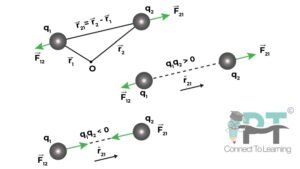
Let:
-
Charge at position vector
-
Charge at position vector
Relative position vectors:
Magnitude:
7️⃣ Unit Vector (Very Important Definition)
A unit vector gives direction only:
-
Points from q₁ to q₂
-
Dimensionless
8️⃣ Vector Form of Coulomb’s Law (NCERT Equation)
Force on charge due to charge :
9️⃣ Direction Interpretation (Built-in Advantage)
-
If → force along → repulsion
-
If → force opposite to → attraction
📌 No separate equations needed for attraction and repulsion
🔟 Newton’s Third Law from Coulomb’s Law
Force on due to :
Since:
✔️ Coulomb’s law automatically satisfies Newton’s third law
Compact Vector Form (Advanced NCERT Form)
📌 Useful for:
-
Superposition
-
Electric field derivation
-
Higher numerical
Important Assumptions of Coulomb’s Law
✔ Charges are point charges
✔ Charges are at rest
✔ Distance ≫ size of charges
✔ Medium is vacuum / air
Experimental Basis (NCERT)
-
Established using torsion balance
-
Valid from macroscopic scale to subatomic distances (~10⁻¹⁰ m)
One-Line Exam Definitions (Very Important)
-
Coulomb’s Law:
The electrostatic force between two point charges is directly proportional to the product of the charges and inversely proportional to the square of the distance between them. -
Unit Vector:
A vector of unit magnitude used to specify direction. -
Permittivity of Free Space:
A constant that characterises the electrical properties of vacuum.
Key Takeaways for Exams
✔ Force ∝
✔ Vector nature essential
✔ Direction decided by sign of charges
✔ Basis of electric field and superposition principle
