
ELECTRIC FIELD
1. Why Do We Need the Concept of Electric Field?
Imagine this question:
If two charges attract or repel each other, how does one charge “know” the other is there—especially when there is empty space between them?
Early scientists struggled with this idea. The solution came from Michael Faraday, who introduced the revolutionary concept of a field.
👉 A charge does not act directly on another charge.
👉 It first creates an electric field in the surrounding space.
👉 Any other charge placed in this field experiences a force.
This idea is the foundation of electrostatics.
⚡ 2. What Is an Electric Field? (Definition)
Electric Field (E) at a point is defined as:
The force experienced by a unit positive test charge placed at that point.
Mathematically,
where
-
F = force on the test charge
-
q = magnitude of the test charge
📌 SI Unit: N/C (newton per coulomb)
🔹 The test charge is taken very small so it does not disturb the original field.
📐 3. Derivation of Electric Field Due to a Point Charge
Consider a point charge Q placed at the origin.
If a small test charge q is placed at distance r, the electrostatic force (by Coulomb’s law) is:
Now, electric field is force per unit charge:
Substituting:
🔍 Key Observations
-
Electric field depends on source charge Q, not on test charge q
-
Direction is:
-
Away from Q if Q is positive
-
Towards Q if Q is negative
-
-
Field decreases as 1/r² with distance
🔗 4. Relation Between Electric Field and Electrostatic Force
The most powerful and exam-important relation is:
💡 Interpretation
-
Electric field describes the electrical environment
-
Force depends on:
-
Strength of field (E)
-
Nature and magnitude of charge (q)
-
🔹 For a positive charge, force is along E
🔹 For a negative charge, force is opposite to E
This relation helps us separate cause (field) from effect (force).
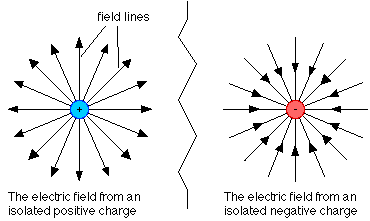
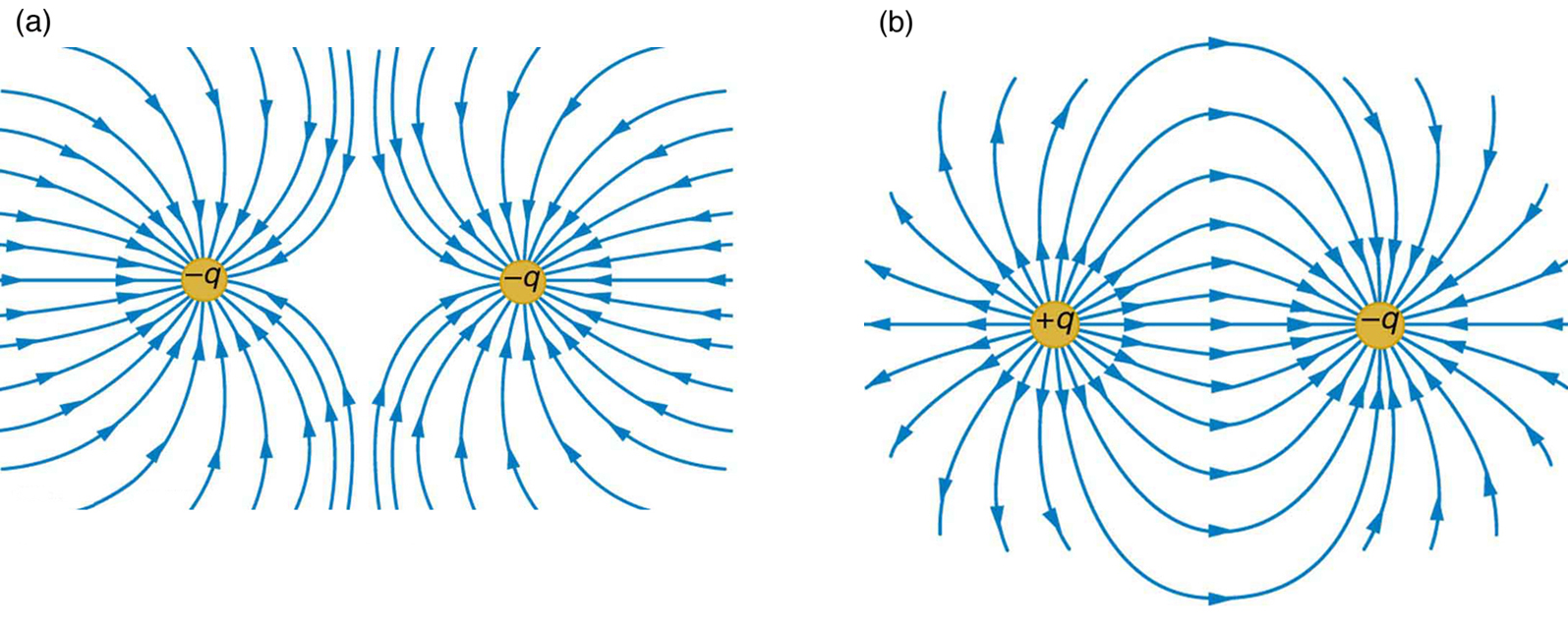
5. Electric Field Lines – Visualising the Invisible
Electric field is invisible, but field lines help us see it.
Definition
Electric field lines are imaginary curves drawn such that:
The tangent at any point gives the direction of the electric field at that point.
6. Properties of Electric Field Lines (Very Important)
(1) Start and End
-
Start from positive charges
-
End on negative charges
-
May start or end at infinity if isolated
(2) Direction
-
Direction of field = direction of force on a positive test charge
(3) Density of Lines
-
Closer lines → stronger field
-
Farther lines → weaker field
This explains why:
(4) Never Intersect
Field lines never cross, because:
-
At a point, electric field has only one direction
(5) No Closed Loops
Electrostatic field lines do not form closed loops, because:
-
Electrostatic field is conservative
⚖️ 7. Electric Field Due to Multiple Charges (Superposition)
If more than one charge is present:
🔹 Electric field follows the principle of superposition
🔹 Add fields vectorially, not algebraically
This makes electric field more powerful than force calculations.
✨ 8. Why Electric Field Is a Brilliant Concept
-
Explains action at a distance
-
Works even when charges are not present
-
Becomes essential in:
-
Electromagnetic waves
-
Time-varying fields
-
Modern physics
-
👉 That’s why field, not force, is the fundamental idea in physics.
📝 Exam-Ready Summary Box
-
-
-
-
Field lines show direction + strength
-
Density ∝ strength of electric field
