
Go Back to Class 12th Physics
Question 3.1
The storage battery of a car has an emf of 12 V. If the internal resistance of the battery is 0.4 Ω, what is the maximum current that can be drawn from the battery?
Solution:
The maximum current is drawn when the external resistance is zero (short-circuit condition).
Given:
Emf of the battery,
Internal resistance,
Maximum current:
Question 3.2
A battery of emf 10 V and internal resistance 3 Ω is connected to a resistor.
If the current in the circuit is 0.5 A,
(i) what is the resistance of the resistor?
(ii) what is the terminal voltage of the battery when the circuit is closed?
Solution:
Given:
Emf of battery,
Internal resistance,
Current,
(i) Resistance of the resistor
For a closed circuit:
(ii) Terminal voltage of the battery
Terminal voltage is given by:
Question 3.3
At room temperature (27.0 °C) the resistance of a heating element is 100 Ω. What is the temperature of the element if the resistance is found to be 117 Ω, given that the temperature coefficient of the material of the resistor is
?
Solution:
Given:
Resistance at ,
Resistance at temperature ,
Temperature coefficient,
The relation between resistance and temperature is:
Substituting the given values:
Question 3.4
A negligibly small current is passed through a wire of length 15 m and uniform cross-section , and its resistance is measured to be What is the resistivity of the material at the temperature of the experiment?
Solution:
Given:
Length of the wire,
Cross-sectional area,
Resistance,
The relation between resistance and resistivity is:
So,
Substituting the values:
Question 3.5
A silver wire has a resistance of 2.1 Ω at 27.5 °C and a resistance of 2.7 Ω at 100 °C. Determine the temperature coefficient of resistivity of silver.
Solution:
Given:
Resistance at ,
Resistance at ,
The relation between resistance and temperature is:
Substituting the values:
Divide both sides by 2.1:
Question 3.6
A heating element using nichrome connected to a 230 V supply draws an initial current of 3.2 A, which settles after a few seconds to a steady value of 2.8 A. What is the steady temperature of the heating element if the room temperature is 27.0 °C? The temperature coefficient of resistance of nichrome (average over the range) is
Solution:
Given:
Supply voltage,
Initial current,
Steady current,
Room temperature,
Temperature coefficient,
Step 1: Find resistance at room temperature
Step 2: Find resistance at steady state
Step 3: Use temperature–resistance relation
Divide both sides by 71.9:
Question 3.7
Determine the current in each branch of the network shown in Fig. 3.20.
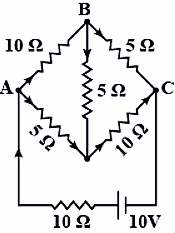
Solution:
From the figure:
-
-
-
-
-
(central branch)
-
External resistor
-
Battery emf
Let the current supplied by the battery be .
Assume currents in the branches as follows:
-
Current in branch
-
Current in branch
-
Current in central branch
Step 1: Apply Kirchhoff’s junction rule
At junction B:
Step 2: Apply Kirchhoff’s loop rule
Loop ABDA:
Loop BCDC:
Step 3: Solve equations
From (3):
Substitute into (1):
Substitute into (2):
Hence:
Step 4: Current from the battery
The Wheatstone bridge is balanced, so no current flows through the central branch.
Only the outer circuit draws current:
This current divides equally in the two side branches.
Final Answer:
-
Current through central branch
-
Current through left branch
-
Current through right branch
-
Total current from the battery = 0.5 A
Question 3.8
A storage battery of emf 8.0 V and internal resistance 0.5 Ω is being charged by a 120 V dc supply using a series resistor of 15.5 Ω.
(i) What is the terminal voltage of the battery during charging?
(ii) What is the purpose of having a series resistor in the charging circuit?
Solution:
Given:
Emf of battery,
Internal resistance,
Supply voltage,
Series resistance,
Step 1: Find the charging current
During charging, the supply emf opposes the battery emf.
Total resistance of the circuit:
Net driving voltage:
Current in the circuit:
Step 2: Terminal voltage of the battery during charging
During charging:
Step 3: Purpose of the series resistor
The series resistor is used to:
-
Limit the charging current to a safe value
-
Prevent damage to the battery due to excessive current
-
Control the rate of charging
-
Protect the dc supply and battery from overheating
Answers:
-
Terminal voltage of the battery during charging =
-
Purpose of series resistor:
To limit and control the charging current and protect the battery.
Question 3.9
The number density of free electrons in a copper conductor estimated in Example 3.1 is
.
How long does an electron take to drift from one end of a wire 3.0 m long to its other end? The area of cross-section of the wire is and it is carrying a current of 3.0 A.
Solution:
Given:
Length of wire,
Area,
Current,
Charge of electron,
Step 1: Find the drift velocity of electrons
Current is given by:
So,
Substitute the values:
Step 2: Time taken to drift through the wire
Step 3: Convert time into hours
