
(UGC NET Performing Arts — Drama & Theatre)
🔶 SECTION A: THEATRE ARCHITECTURE
1. Introduction
Theatre architecture refers to the spatial design of performance venues—defining the relationship between actor, audience, and action. It affects visibility, acoustics, stage mechanics, and overall aesthetics.
UGC-NET questions often test your ability to differentiate between stage types, classical theatres, and their structural purposes.
2. Greek Theatre
-
Period: 5th century BCE, Athens; origin of Western drama.
-
Structure:
-
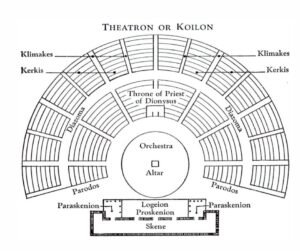
Theatron: audience seating on hillside.
-
Orchestra: circular performance space for chorus and actors.
-
Skene: stage house (for costume changes, entrances, background).
-
Parodos: passageways for chorus entry.
-
-
Features:
-
Open-air; natural acoustics.
-
Use of masks, elevated boots (cothurni).
-
Performance integrated with religious festivals (Dionysia).
-
-
Design Purpose: Semi-circular space for voice projection and ritual drama.
-
Exam Focus: Identify elements like orchestra, skene, parodos, and their functions.
3. Roman Theatre
-
Period: 3rd century BCE onward.
-
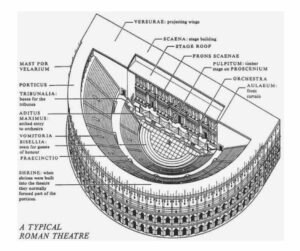
Structure: Semi-circular orchestra, scaenae frons (decorated façade), and free-standing building.
-
Innovations:
-
Stage machinery, curtains, trapdoors.
-
Enclosed auditorium (better acoustics).
-
More focus on spectacle than ritual.
-
-
Exam Tip: Know the difference—Greek theatres were built into hillsides; Roman theatres were freestanding.
4. Elizabethan Theatre
-
Example: The Globe Theatre (1599, London).
-
Features:
-
Thrust stage projecting into audience.
-
Open-air, circular or polygonal structure.
-
“Heavens” above stage, “Hell” trapdoors below.
-
Minimal sets, rich costumes.
-
-
Purpose: Encouraged direct actor-audience interaction.
-
Exam Insight: 2020 UGC-NET asked: “Which theatre used the thrust stage form?” — Elizabethan.
5. Thrust Stage (Modern Form)
-
Design: Audience on three sides, open playing area.
-
Advantage: Intimacy and actor visibility.
-
Used in: Shakespeare festivals, experimental theatre.
-
Challenge: Blocking for multiple sightlines.
6. Proscenium Stage
-
Definition: Picture-frame stage; audience faces one side.
-
Components: Proscenium arch, wings, fly loft, curtain line.
-
Advantages:
-
Illusionistic scenery, detailed sets.
-
Controlled lighting and sound.
-
-
Used in: Realist/Naturalist theatre (Antoine, Stanislavsky, Alkazi).
-
Exam Tip: The “fourth wall” concept arises from proscenium staging.
7. Arena Theatre (Theatre-in-the-Round)
-
Structure: Audience surrounds the stage on all sides.
-
Features: Minimal scenery, intense intimacy.
-
Blocking: Actors must move continuously for all-round visibility.
-
Modern Examples: Grotowski’s Poor Theatre and environmental theatre.
8. Open Stage / Black Box
-
Black Box Theatre: Neutral, flexible, small space with movable seating and stage.
-
Use: Experimental, minimalist, educational productions.
-
Advantage: Adaptability to any style.
-
Common in: Modern Indian repertories and college theatre.
9. Sanskrit Theatre – Natyagruha
-
Source: Natyashastra (Bharata Muni).
-
Three Types of Playhouses:
-
Vikr̥ṣṭa: Large theatre (for gods and kings).
-
Madhyama: Medium theatre (for mixed audiences).
-
Kṣudra: Small theatre (for common folk).
-
-
Features:
-
Rectangular plan, divided into three zones:
-
Ranga (performance area),
-
Nepathya (backstage),
-
Parishkr̥ta (audience area).
-
-
Emphasis on sacred geometry, auspicious directions, ritual performance.
-
-
Exam Tip: Distinguish between Vikr̥ṣṭa and Madhyama Natyagruha—often asked directly.
10. Chinese and Japanese Classical Playhouses
a) Chinese Theatre
-
Structure: Raised platform, no curtain, musicians on stage.
-
Architecture: Simple wooden framework, elaborate backdrops.
-
Performance space: Symbolic and non-realistic.
-
Example: Peking Opera theatres.
b) Japanese Noh & Kabuki Stages
-
Noh: Roofed platform with polished wooden floor, pine tree backdrop (kagami-ita), bridgeway (hashigakari).
-
Kabuki: Proscenium stage with hanamichi (runway into audience), revolving platforms, trapdoors.
-
Philosophy: Noh—minimalism and ritual; Kabuki—spectacle and energy.
🔶 SECTION B: STAGECRAFT AND DESIGN ELEMENTS
UGC-NET regularly tests functions and fundamentals of each design discipline. Questions often appear in “Match the following” format.
1. Scenic Design / Set Design
-
Purpose: Defines location, time period, mood.
-
Types:
-
Realistic: Replicates real environment.
-
Stylised/Abstract: Symbolic or non-realistic forms.
-
Unit set: Adaptable structures for multiple scenes.
-
-
Principles:
-
Visual balance, proportion, perspective, masking, actor movement.
-
2. Lighting Design
-
Functions:
-
Visibility.
-
Focus and emphasis.
-
Mood creation.
-
Indicating time/place.
-
Composition and rhythm.
-
-
Elements:
-
Intensity (brightness).
-
Colour (emotional tone).
-
Direction (angle of light).
-
Distribution (spread and focus).
-
Movement (fades, transitions).
-
-
Instruments:
-
Fresnel: Soft wash.
-
Profile/ERS: Sharp spotlight.
-
PAR Can: High-intensity beam.
-
Floodlights: General illumination.
-
Follow Spot: Tracks actors dynamically.
-
-
Designers to Remember:
-
Adolphe Appia, Gordon Craig, Tapas Sen (India).
-
-
Exam Tip: Questions often ask, “Who is known as India’s pioneer of modern stage lighting?” → Tapas Sen.
3. Costume Design
-
Function: Visual storytelling—reveals character, era, social rank, personality.
-
Elements: Line, silhouette, colour, texture, fabric, accessories.
-
Process: Script analysis → sketches → fittings → coordination with lighting.
-
Ahārya Abhinaya: Costumes and makeup in Natyashastra tradition are part of expressive communication.
-
Exam Tip: Match costume features to their dramatic functions (e.g., “Costume indicates social status”—True).
4. Make-up
-
Purpose: Enhance facial expression, define age/character type, ensure visibility.
-
Types:
-
Corrective (stage definition),
-
Character (specific transformation),
-
Stylised (ritual, e.g., Kathakali).
-
-
In Traditions:
-
Kabuki uses bold colour symbolism,
-
Kathakali uses chutti makeup for divine/evil characters.
-
-
Exam Tip: “Which Abhinaya type includes makeup?” → Ahārya.
5. Sound Design
-
Functions: Adds realism, mood, continuity.
-
Types:
-
Live: Musicians, onstage effects.
-
Recorded: Background score, ambient sound.
-
-
Elements: Pitch, tempo, rhythm, volume, transition.
-
Exam Tip: Distinguish diegetic (within scene) vs non-diegetic (background) sound.
6. Props (Property)
-
Definition: Any object used onstage by actors.
-
Types:
-
Hand props (books, swords),
-
Set props (furniture),
-
Decorative props (paintings),
-
Personal props (accessories).
-
-
Function: Enhance realism, character identity, or symbolic meaning.
7. Theatre Music
-
Function: Supports action, emotional tone, rhythm, and atmosphere.
-
In Indian Theatre: Music is integrated (e.g., Sangeet Natak, Yakshagana, Bhand Pather).
-
Modern Use: Underscoring scenes, leitmotifs for characters.
🔶 SECTION C: AHĀRYA & NEPATHYA VIDHI
1. Ahārya Vidhi
-
Described in Natyashastra as external expression through costume, ornamentation, and scenic presentation.
-
Includes:
-
Costumes (Vastra),
-
Jewellery (Ābharaṇa),
-
Makeup (Varnana),
-
Set decor (Āsana, Vedi),
-
Visual motifs.
-
-
Purpose: Symbolic visual communication of rasa and character identity.
-
Exam Example: “Ahārya Abhinaya deals with — Costume, ornaments, and makeup.”
2. Nepathya Vidhi
-
Refers to backstage organization—preparation, rituals, prop storage, stage management.
-
Functions:
-
Actor readiness (Sajjīkaraṇa),
-
Quick changes,
-
Offstage coordination.
-
-
Ritual Significance: Sanctifies the performance process; backstage is a sacred space.
-
Exam Tip: “Nepathya is related to—Backstage arrangement and rituals.”
3. Comparative Classical Contexts
| Tradition | Ahārya Example | Nepathya Example |
|---|---|---|
| Sanskrit | Colour-coded costumes per rasa | Sutradhāra managing greenroom |
| Chinese Opera | Painted masks & embroidered robes | Stagehands as assistants |
| Noh Theatre | Masks, silk robes | Ritual preparation backstage |
| Kabuki | Ornate wigs, kimono | Family apprentices maintaining costumes |
🔶 SECTION D: THEATRE MANAGEMENT AND ORGANIZATION
1. Structure of a Theatre Organization
-
Artistic Head: Director or Artistic Director.
-
Production Team: Designers, technicians, stage manager.
-
Administrative Wing: Managing director, marketing, finance, publicity, education outreach.
-
Front of House: Ushers, box office, audience management.
2. Production Process
-
Script selection → Design meetings → Casting → Rehearsal → Technical run → Dress rehearsal → Performance → Evaluation.
3. Budgeting and Finance
-
Expenses: Salaries, set construction, costume, lighting, publicity.
-
Revenue: Grants, ticket sales, sponsorships, educational programs.
4. Safety and Legal Aspects
-
Fire exits, electrical compliance, stage insurance, child performer laws.
5. Audience Development
-
Educational outreach, subscriptions, social media marketing, community engagement.
🔶 SECTION E: CHILDREN’S & APPLIED THEATRE FORMS
1. Children’s Theatre
-
Focus: Educational and imaginative growth.
-
Features:
-
Storytelling, puppetry, song, movement.
-
Bright visuals, simple language, moral themes.
-
-
Purpose: Cognitive development, empathy, teamwork.
-
Exam Question: “Children’s theatre aims at—Educational and creative development.”
2. Theatre in Education (TIE)
-
Originated in the UK; now used worldwide.
-
Objective: Teaching through participation and performance.
-
Methods: Role-play, storytelling, improvisation, interactive workshops.
-
Exam Tip: “TIE uses drama as an educational tool.”
3. Applied Theatre
-
Definition: Theatre used for social transformation (outside conventional stage).
-
Forms: Prison theatre, hospital theatre, community workshops.
-
Function: Healing, awareness, empowerment.
4. Community Theatre
-
Nature: Created by and for local communities.
-
Themes: Local issues—inequality, education, environment.
-
Indian Examples: Jana Natya Manch (Safdar Hashmi), Naya Theatre (Habib Tanvir).
-
Form: Street theatre, folk-inspired.
5. Theatre of the Oppressed (Augusto Boal)
-
Concept: Theatre as a rehearsal for revolution.
-
Key Forms:
-
Forum Theatre: Audience intervenes to solve problems.
-
Image Theatre: Freeze-frame expression of oppression.
-
Invisible Theatre: Public performance without audience awareness.
-
-
Exam Tip: “Who developed Theatre of the Oppressed?” → Augusto Boal.
6. Feminist Theatre
-
Goal: Challenge patriarchal narratives; give women voice and agency.
-
Methods: Testimonial performances, devised theatre, autobiographical monologues.
-
Indian Context: Dina Pathak, Maya Rao, Mallika Sarabhai.
-
Themes: Gender politics, body image, intersectionality.
🔶 SECTION F: SYNTHESIS AND EXAM REVISION CHART
| Area | Key Focus | Likely Question Type |
|---|---|---|
| Theatre Architecture | Greek, Roman, Proscenium, Sanskrit | Match or MCQ (e.g., “Which has hanamichi?”) |
| Stagecraft | Lighting, Set, Costume, Makeup | Functions & definitions |
| Classical Terms | Ahārya, Nepathya | Short definitions |
| Management | Theatre organization | Assertion–Reason type |
| Applied Forms | Children’s, TIE, Boal | Concept–creator match |
🔶 SECTION G: MODEL UGC-NET QUESTION THEMES
-
Match the following:
(a) Hanamichi — (Kabuki)
(b) Orchestra — (Greek)
(c) Natyagruha — (Sanskrit)
(d) Proscenium — (Illusionistic realism) -
“Ahārya Abhinaya” deals with —
→ Costume, ornaments, and scenic presentation. -
Theatre of the Oppressed encourages —
→ Spect-actor participation. -
Who is considered the pioneer of stage lighting design in India?
→ Tapas Sen. -
Vikr̥ṣṭa Natyagruha refers to —
→ Large theatre layout in Sanskrit tradition.
🔶 CONCLUSION
Unit 9 demands technical precision and conceptual clarity.
For UGC-NET:
-
Architecture & Stagecraft form 50% of questions.
-
Classical Indian terms (Ahārya, Nepathya) appear frequently in matching or short MCQs.
-
Lighting, Costume, Props are tested for function and designer name recognition.
-
Applied Theatre and Children’s Theatre check theoretical understanding and purpose.
Pro Tip:
Revise using comparative charts (Greek vs Sanskrit vs Proscenium), remember designer names, and rehearse definitions of classical terms. Connect Indian traditions to global contexts for essay questions.
