
(Unit 1 – Microeconomics | UGC NET Economics)
1. Introduction
The Theory of Production examines how resources (inputs) are transformed into goods and services (outputs) efficiently.
Production is not limited to manufacturing — it includes any process that adds value by converting inputs into more valuable outputs.
This topic explores two major areas:
-
Theory of Production – how firms combine inputs to produce output efficiently.
-
Theory of Costs – how costs behave as output changes and influence production decisions.
2. Classification of Inputs
Production uses a variety of inputs, broadly categorized as:
| Input Type | Examples | Characteristics |
|---|---|---|
| Labour | Human effort in production | Variable and mobile |
| Capital | Machinery, buildings, tools | Fixed in short run, variable in long run |
| Land | Natural resources | Fixed supply |
| Raw Materials | Inputs directly used in production | Variable with output |
| Time | Production duration | Affects cost and efficiency |
| Technology | Knowledge, innovation | Determines production efficiency |
3. Production Function
The production function represents the technological relationship between inputs and output:
Where:
= Output,
= Labour,
= Capital.
It expresses maximum output possible for given input combinations under existing technology.
Features
-
Shows technological possibilities, not costs.
-
Can be short-run (with fixed inputs) or long-run (all inputs variable).
-
Helps derive marginal productivity and returns to scale.
4. Short-Run and Long-Run Production
| Time Frame | Characteristics | Example |
|---|---|---|
| Short Run | Only one factor (usually labour) is variable; capital fixed. | Hiring more workers in an existing plant. |
| Long Run | All factors variable; firms can change production scale. | Building a new plant or expanding capacity. |
5. Law of Variable Proportions (Short Run)
Also known as the Law of Diminishing Returns.
It explains the effect of varying one input while keeping others fixed.
Statement
When additional units of a variable factor (e.g., labour) are applied to a fixed factor (e.g., land or capital), total output initially increases at an increasing rate, then at a diminishing rate, and eventually may decline.
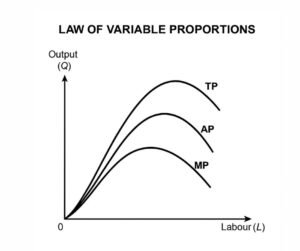
Three Stages of Production
| Stage | Behaviour of Output | Economic Meaning |
|---|---|---|
| Stage I – Increasing Returns | TP and MP rise rapidly | Underutilization of fixed factor |
| Stage II – Diminishing Returns | TP rises at decreasing rate | Optimal production zone |
| Stage III – Negative Returns | TP declines; MP negative | Overcrowding of variable input |
6. Isoquant Analysis (Long-Run Production)
Isoquant
An isoquant curve represents combinations of two inputs (labour and capital) yielding the same level of output.
It is analogous to an indifference curve in consumer theory.
Properties of Isoquants
-
Downward sloping: To maintain output, more of one input requires less of the other.
-
Convex to origin: Reflects diminishing Marginal Rate of Technical Substitution (MRTS).
-
Do not intersect: Each represents distinct output level.
-
Higher isoquants: Indicate higher output levels.
Iso-Cost Line
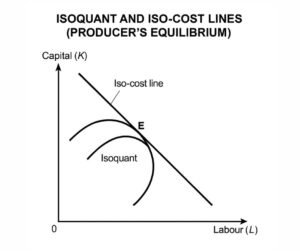
Represents all input combinations a firm can buy for a given cost:
Where = wage rate and = rental rate of capital.
Slope = -w/r
Producer’s Equilibrium
Occurs where the isoquant is tangent to an iso-cost line:
This represents the least-cost combination of inputs.
7. Returns to Scale (Long Run)
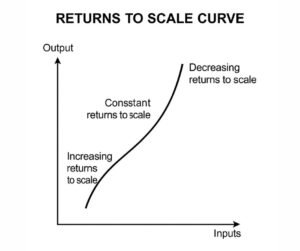
Examines how output responds to a proportionate change in all inputs.
| Type | Description | Example |
|---|---|---|
| Increasing Returns to Scale (IRS) | Output increases more than proportionally. | Inputs ↑ 100% → Output ↑ > 100% |
| Constant Returns to Scale (CRS) | Output increases proportionally. | Inputs ↑ 100% → Output ↑ 100% |
| Decreasing Returns to Scale (DRS) | Output increases less than proportionally. | Inputs ↑ 100% → Output ↑ < 100% |
Determinants of Returns to Scale
-
Indivisibility of inputs (e.g., machinery)
-
Specialization and division of labour
-
Managerial and technical efficiencies
-
Coordination challenges (for decreasing returns)
8. Theory of Costs
Cost refers to the expenditure incurred in producing goods and services.
It links production theory with financial decision-making.
Types of Costs
| Cost Type | Definition | Example |
|---|---|---|
| Explicit (Actual) | Direct payments for inputs | Wages, rent, raw materials |
| Implicit (Imputed) | Value of self-owned resources | Owner’s labour, capital |
| Business Costs | Explicit + depreciation | Operational cost |
| Full Costs | Business + opportunity + normal profit | Economic cost |
| Out-of-Pocket | Cash payments | Wages, transport |
| Book Costs | Non-cash, accounting | Depreciation |
| Fixed Costs (TFC) | Remain constant with output | Rent, salaries |
| Variable Costs (TVC) | Vary with output | Raw materials, wages |
Cost Functions
Relationships:
-
When MC < AC → AC falls
-
When MC > AC → AC rises
-
MC intersects AC at its minimum point
9. Cost Curves
Short-Run Cost Curves
-
AFC decreases continuously.
-
AVC and ATC are U-shaped due to economies and diseconomies of scale.
-
MC cuts both AVC and ATC at their minimum points.
Long-Run Cost Curves
-
All costs are variable.
-
LAC is the envelope of SRACs.
-
Traditionally U-shaped: reflects economies → constant returns → diseconomies of scale.
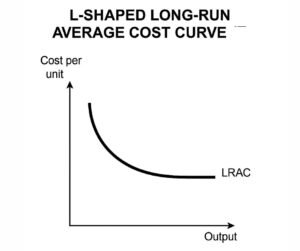
Modern (L-Shaped) Long-Run Cost Curve
-
Empirical evidence shows costs flatten out at high output.
-
Due to:
-
Reserve capacity of plants
-
Learning curve and technical improvement
-
Economies persisting at large scale
-
10. Economies and Diseconomies of Scale
| Economies | Diseconomies |
|---|---|
| Internal: technical, managerial, marketing, financial, risk spreading | Managerial inefficiency, coordination failure, communication delays |
| External: industry growth, localization, shared infrastructure | Resource scarcity, input price rise |
11. Relationship Between Production and Cost
-
As Marginal Product rises → Marginal Cost falls.
-
When MP falls → MC rises.
Thus, productivity curves and cost curves are mirror images.
12. Private and Social Costs
| Type | Meaning |
|---|---|
| Private Cost | Costs borne by the firm itself. |
| Social Cost | Private + external costs (e.g., pollution, congestion). |
13. Key Definitions
| Term | Definition |
|---|---|
| Isoquant | Curve showing input combinations yielding same output |
| MRTS | Rate of technical substitution between inputs |
| Fixed Cost | Cost that does not vary with output in short run |
| Marginal Cost | Cost of producing one additional unit |
| Economies of Scale | Cost advantages from larger scale |
| Social Cost | Total cost to society (private + external) |
14. Important Graphs
1️⃣ Law of Variable Proportions
2️⃣ Isoquant–Iso-Cost Tangency (Producer’s Equilibrium)
3️⃣ Returns to Scale Curve
4️⃣ L-shaped Long-Run Average Cost Curve
(Refer to the attached academic diagrams page for illustration.)
15. Summary Table for UGC NET
| Concept | Focus | Key Relation |
|---|---|---|
| Short-Run Law | Variable proportions | TP, MP, AP behaviour |
| Long-Run Law | Returns to scale | IRS, CRS, DRS |
| Isoquant Analysis | Producer equilibrium | |
| Cost Analysis | U and L-shaped curves | MC–AC interaction |
| Scale Effects | Economies vs. Diseconomies | Internal & External |
