
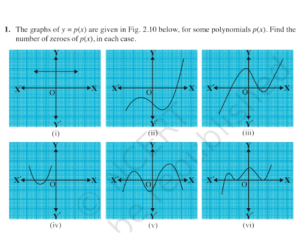
How to find number of zeroes from a graph
-
A zero (root) of is an -value where — i.e., where the graph meets the x-axis.
-
Count the distinct x-axis intersection points:
-
If the graph crosses the x-axis at a point → that counts as one distinct zero.
-
If the graph just touches the x-axis and turns around there (tangent) → that counts as one zero (a repeated/double root).
-
If the graph never meets the x-axis → zero real zeroes.
-
If the graph meets the x-axis at distinct points → there are real zeroes (max for degree ).
-
Common examples (so you know what to look for)
-
Straight line crossing x-axis once → 1 zero.
-
Parabola crossing x-axis twice → 2 zeroes.
-
Parabola tangent to x-axis (touches once) → 1 zero (double).
-
Cubic curve that crosses three times → 3 zeroes.
-
Curve entirely above/below x-axis → 0 zeroes.
-
Higher-degree curve crossing 4 separate times → 4 zeroes.
(There’s an earlier worked example in the book — Fig. 2.9 — where the answers were: (i)1, (ii)2, (iii)3, (iv)1, (v)1, (vi)4. That’s the same idea you’ll apply to Fig. 2.10.)
